What Is a Book Series and How Is It Structured? A Complete Guide
18 November 2026 · 7 min read
Have you ever finished reading a book and discovered that its characters and story continue in another volume? This is one of the most enjoyable aspects of reading a book series.
A book series is a collection of related books connected through characters, settings, themes, storylines, or a shared fictional world. Each book may introduce new events and developments while contributing to a larger reading experience.
Book series are popular across many genres, including fantasy, mystery, romance, science fiction, historical fiction, and children's literature.
However, creating a successful book series requires more than dividing one long story into several volumes. Writers need to plan how individual books connect, how characters develop, and how readers move from one book to another.
Whether you're planning a fantasy adventure, a mystery collection, or a series of independent stories, understanding different series structures can help you organize your writing effectively.
1. What Is a Book Series?
A book series is a group of books connected by one or more common elements.
These connections might include recurring characters, a continuing storyline, a shared location, a particular theme, or an imaginary universe.
For example, a fantasy series might follow the same group of characters through several adventures. A mystery series might feature one detective investigating different cases in each volume.
Some series are designed to be read in a specific order, while others allow readers to enjoy individual books independently.
The important feature is that the books share a recognizable connection that makes them part of the same collection.
2. What Are the Main Types of Book Series?
Book series can be structured in different ways depending on the author's creative goals and the type of reading experience they want to provide.
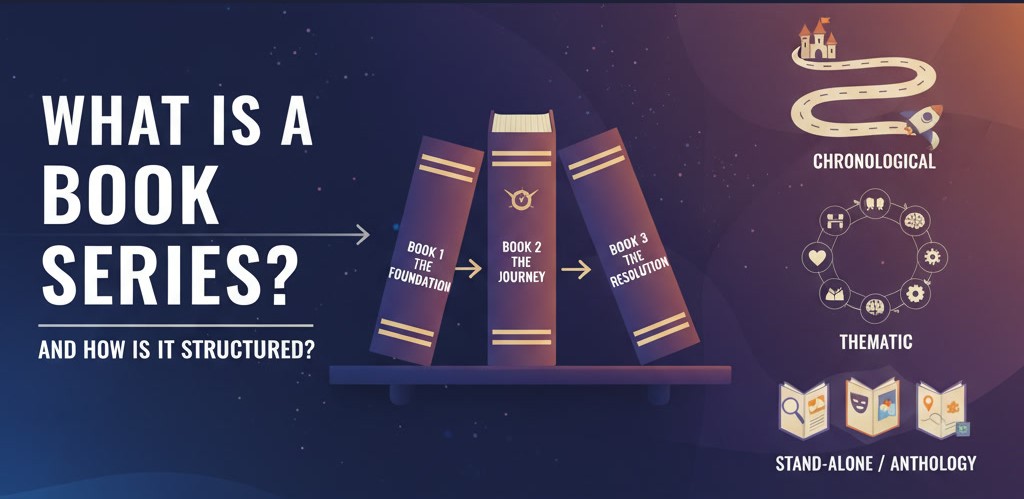
Three common approaches are chronological, thematic, and standalone or anthology structures.
Chronological Book Series
A chronological series follows events in a particular order. Each book continues the story from the previous volume.
Characters develop, relationships change, and important events influence what happens next.
For example:
Book 1: The Foundation
Book 2: The Journey
Book 3: The Resolution
This structure is common in fantasy adventures, science fiction, historical fiction, and other stories involving long-term character development.
Writers using chronological structures should maintain continuity between books. Important events, character relationships, timelines, and earlier decisions should remain consistent.
Readers generally benefit from following the recommended reading order because later books depend on information introduced earlier.
Thematic Book Series
A thematic series connects books through shared subjects, ideas, settings, or concepts rather than one continuous storyline.
Each book may introduce different characters and situations while exploring a common theme.
For example, a writer might create a series of mystery books, each exploring a different historical location. Another author might produce several personal development books focused on different aspects of everyday life.
Thematic connections allow writers to explore related subjects without requiring every volume to continue the same plot.
This structure can also make individual books more accessible to new readers.
Standalone Books and Anthologies
Standalone books are complete stories that can generally be enjoyed without reading other volumes.
A writer may publish several standalone novels connected through a shared fictional world, setting, genre, or collection.
Anthologies are collections of separate stories, often written by different authors, organized around a common theme or subject.
For example, an anthology might contain several short stories about mysterious journeys, historical adventures, or unexpected discoveries.
These formats provide variety and allow readers to explore different stories without following a single continuous narrative.
3. Choose a Structure That Matches Your Story
Before writing the first book, consider which structure best supports your idea.
If your story involves a long adventure with evolving characters and continuing conflicts, a chronological series may be suitable.
If you want to explore different characters or situations connected through a shared subject, a thematic structure may work better.
If each book should offer a complete reading experience, standalone stories or an anthology may be appropriate.
Think about your intended audience and how you want readers to approach the collection.
Choosing a suitable structure early can make planning and writing more manageable.
4. Develop Consistent Characters and Settings
When several books share characters or a fictional world, consistency becomes particularly important.
Readers may notice changes in personalities, relationships, locations, or historical details.
Create notes about your important characters, including their backgrounds, appearances, motivations, relationships, and development.
You can also prepare a series reference document containing information about:
Main and supporting characters.
Important locations.
Historical timelines.
Fictional rules and traditions.
Major events.
Relationships between different books.
Keeping these details organized can help prevent continuity problems as your series grows.
5. Plan Each Book and the Complete Series
A successful book series needs both individual story planning and an overall direction.
Each volume should offer something meaningful while contributing to the larger collection.
For a chronological series, identify the major events and developments that connect the books.
For a thematic series, decide which common ideas or subjects will unite the different volumes.
For standalone books, make sure each story has its own beginning, central conflict, and satisfying conclusion.
You do not need to plan every sentence before writing. However, having a general outline can help you maintain consistency and avoid unnecessary repetition.
6. Give Every Book Its Own Identity
Although books in a series should feel connected, each volume should also offer something distinctive.
Introduce new challenges, discoveries, characters, settings, or perspectives.
Avoid repeating the same storyline in every book.
For example, a mystery series might feature a different investigation in each volume while retaining its central detective.
A fantasy series might explore new locations and conflicts as the larger fictional world develops.
Readers should recognize the series while discovering something interesting in every new book.
7. Organize the Reading Order Clearly
Reading order is particularly important when books contain continuing storylines.
Use consistent numbering, titles, and descriptions to help readers identify the correct sequence.
For chronological series, clearly indicate which book comes first.
For thematic or standalone collections, explain whether the books can be read independently.
You can also include a series page on your author website listing every volume in the recommended order.
Clear organization helps readers discover your work and makes it easier for new audiences to enter the series.
8. Avoid Common Book Series Writing Mistakes
Some challenges can affect the quality of a book series if they are not addressed during planning.
Common mistakes include:
Inconsistent characters: Keep important character details and development consistent.
Repetitive storylines: Give each volume a distinctive conflict or purpose.
Unclear reading order: Explain how books connect and whether sequence matters.
Incomplete individual stories: Give each volume a suitable structure and resolution.
Too much unnecessary information: Introduce world-building details naturally.
Losing the central theme: Maintain a recognizable connection throughout the collection.
Reviewing these aspects during editing can help strengthen the complete series.
9. Edit and Prepare Your Book Series for Publication
Before publishing, review each manuscript individually and examine how it fits into the larger collection.
Check character continuity, story progression, chapter organization, formatting, and consistency.
For a chronological series, pay particular attention to timelines and previous events. For thematic and standalone collections, make sure each book clearly communicates its individual purpose.
Professional editing and proofreading can improve clarity, structure, and presentation.
If you need assistance developing or preparing your manuscripts, explore writing, editing, proofreading, publishing, and book marketing services through Book Writting Ltd at https://bookwritting.com/.
A book series allows authors to expand their creative ideas across multiple connected books.
Whether you choose a chronological, thematic, or standalone structure, the right approach depends on your story, characters, intended audience, and publishing goals.
Plan your collection carefully, develop consistent characters, give every volume a meaningful purpose, and make the reading order easy to understand.
Remember that a successful series should offer both a connection between books and an enjoyable experience within each individual volume.
With thoughtful planning, creative storytelling, and careful revision, you can develop a book series that keeps readers interested and encourages them to explore more of your work.