Writing Thrillers | How to Create Unforgettable Plot Twists
1 October 2026 · 7 min read
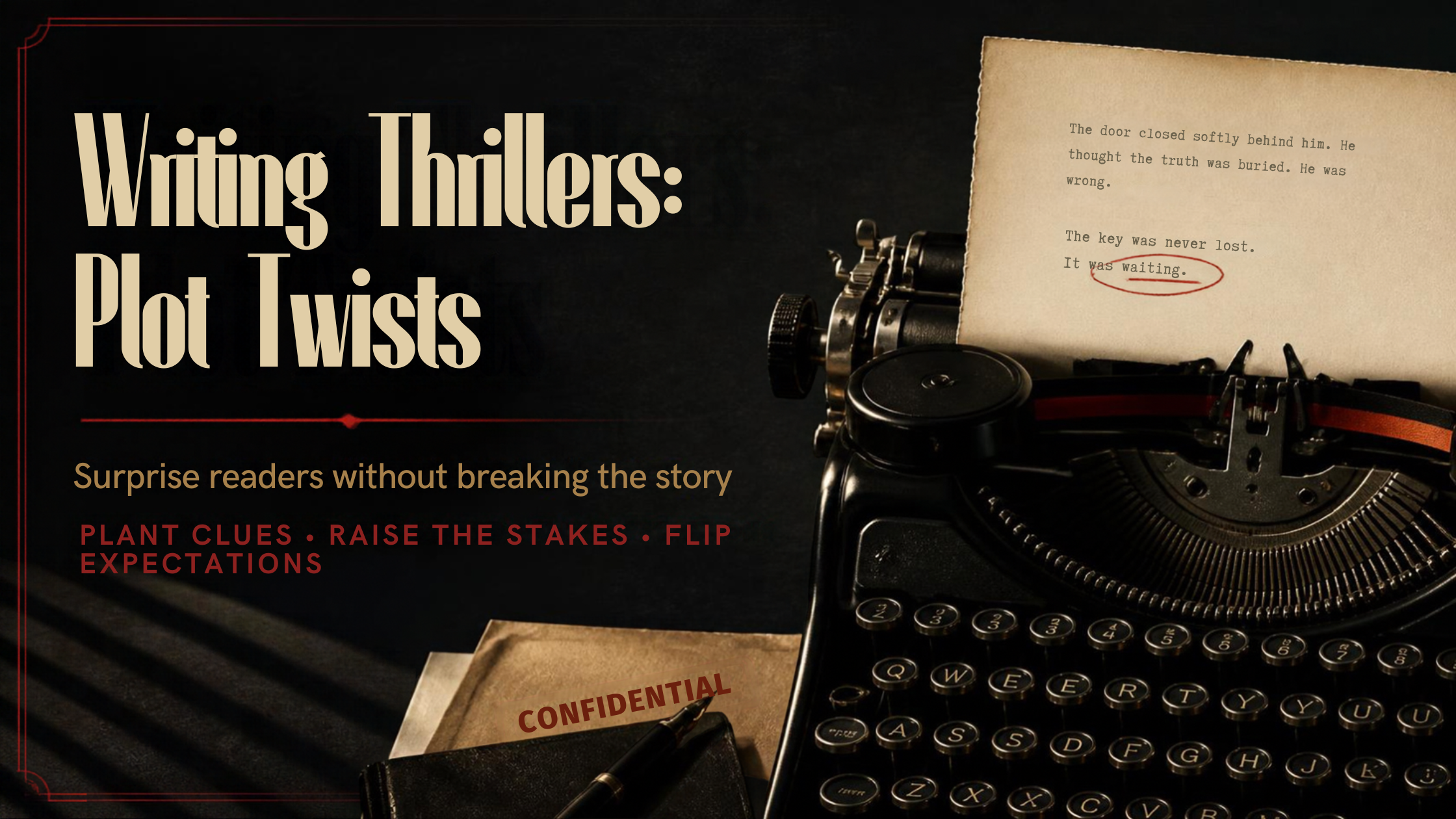
A great thriller keeps readers asking questions. Who can be trusted? What is really happening? Will the protagonist escape? And perhaps most importantly, what will happen next?
One of the most effective ways to keep readers engaged is through a well-crafted plot twist. A plot twist introduces an unexpected development or revelation that changes the reader's understanding of the story. In thrillers, twists work especially well because the genre depends heavily on suspense, danger, conflict, and unexpected events.
However, simply adding a shocking surprise isn't enough. A strong twist should feel unexpected while still making sense when readers look back at the earlier chapters. The goal is to surprise readers without making them feel that the author changed the rules of the story.
Here are practical techniques for creating effective thriller plot twists.
1. Start With a Strong Central Conflict
Before thinking about twists, establish the main problem of your thriller.
Ask:
What does the protagonist want?
What stands in their way?
What happens if they fail?
Who or what is creating the danger?
What information is hidden from the protagonist?
Thrillers often rely on high stakes and escalating danger. The protagonist should have something meaningful to lose, whether that involves their safety, relationships, reputation, freedom, or the lives of others.
A strong central conflict gives your twists somewhere to go. Without a compelling problem, even a surprising reveal can feel disconnected.
2. Decide What the Reader Believes
A plot twist works by changing an expectation.
First, establish what readers currently believe to be true.
For example:
Reader assumption: The protagonist's best friend is helping solve the mystery.
Later, you could reveal:
New information: The friend has been hiding information that completely changes the investigation.
The twist becomes effective because readers had already formed an expectation.
Before writing your reveal, write down:
What does the reader believe?
Then ask:
What information could change that belief?
This simple exercise can help you discover potential twists.
3. Foreshadow the Twist
One of the most important elements of a satisfying twist is preparation.
Foreshadowing gives readers clues about something that will become important later. These clues might involve an object, conversation, character behavior, location, memory, or seemingly insignificant detail.
The trick is subtlety.
If your clue is too obvious, readers may solve the twist immediately.
If there is no clue at all, the twist may feel random.
A useful approach is to plant information that has an innocent explanation when first introduced but gains a different meaning after the reveal.
4. Use Red Herrings Carefully
A red herring is a misleading clue that encourages readers to consider the wrong explanation.
For example, you might introduce suspicious behavior from one character. Readers naturally begin wondering whether that person is responsible for the central problem.
Later, they discover that the suspicious behavior had another explanation.
Red herrings can create uncertainty and encourage readers to form theories. However, they should support the story rather than exist only to trick the audience.
Your goal isn't simply to fool readers.
Your goal is to make them wonder.
5. Make the Twist Change the Story
A good thriller twist should have consequences.
The reveal should change what the protagonist needs to do, what they understand, or who they can trust.
For example:
Before the twist:
The protagonist is trying to find a missing person.
After the twist:
The protagonist discovers that the missing person has been secretly controlling the investigation.
Now the story has changed direction.
Effective thriller twists can reorder the meaning of earlier events rather than functioning as isolated surprises.
6. Keep the Protagonist Active
A twist becomes more powerful when the protagonist has to react to it.
Don't allow your main character to simply receive information and continue as before.
After a major reveal, ask:
What does the protagonist do now?
What new danger has appeared?
What decision must they make?
What resource have they lost?
Who can they trust?
What is the worst possible consequence?
Thriller plotting benefits from escalating complications that continually force the protagonist to respond.
7. Increase the Stakes After Each Major Reveal
Not every twist needs to be bigger than the previous one, but the consequences should continue to develop.
Imagine this progression:
Reveal 1: Someone has been lying.
Reveal 2: The lie is connected to the central mystery.
Reveal 3: The protagonist is personally involved.
Reveal 4: The person the protagonist trusted most is connected to the truth.
Each discovery changes the situation and pushes the protagonist closer to the climax.
This creates forward momentum instead of a series of unrelated surprises.
8. Don't Add Twists Just to Shock Readers
A common mistake in thriller writing is adding twists simply because the author wants to surprise the audience.
A twist should serve the story.
Before keeping a major reveal, ask:
Does this change the story?
Does it affect the protagonist?
Was it possible based on the information already established?
Will readers understand it once the truth is revealed?
If the answer is no, the twist may need more development.
Storytelling guidance from Reedsy similarly emphasizes that twists need narrative logic and sufficient setup rather than appearing completely out of nowhere.
9. Consider Writing the Ending Early
Knowing your ending can make plotting a thriller much easier.
You don't necessarily need to write the final chapter first, but you should understand where the story is going.
Once you know the final revelation, you can work backward and plant clues throughout the manuscript.
A seven-point story structure, for example, can be planned backward from the resolution and can be useful for thrillers and mysteries.
Ask yourself:
What does the reader need to see before the final reveal for the ending to feel earned?
Then plant those elements throughout the story.
10. Use Suspense Between the Twists
A thriller shouldn't depend entirely on major plot twists.
Suspense keeps readers engaged between revelations.
You can create suspense by:
Hiding important information
Giving readers partial answers
Creating time pressure
Introducing new dangers
Ending chapters with unanswered questions
Allowing characters to make risky decisions
Showing information that the protagonist doesn't know
Suspense can operate across the whole narrative or within individual scenes and chapters.
This gives your thriller momentum even when there isn't a major revelation.
11. Make the Final Twist Earned
The final twist often receives the most attention, but it still needs to follow the rules established by your story.
A satisfying ending should answer the major questions while resolving the central conflict.
Readers don't necessarily need to predict the twist. However, once they discover the truth, they should be able to look back and recognize why the clues were there.
That creates the satisfying feeling of:
“I didn't see it coming—but it makes sense.”
12. Revise Your Twists During Editing
Your first draft doesn't have to contain perfect twists.
During revision, examine every major reveal.
Create a simple list:
Twist | Earlier Clues | Character Impact | Consequence |
|---|---|---|---|
Reveal 1 | Chapter 3 | Changes investigation | New suspect |
Reveal 2 | Chapter 7 | Breaks trust | New threat |
Reveal 3 | Chapter 12 | Changes protagonist's goal | Final confrontation |
This can help you identify twists that appear without enough preparation or consequences.
You can then add earlier clues, adjust pacing, or remove unnecessary reveals.
Writing thriller plot twists is less about creating the most shocking surprise possible and more about controlling information.
Give readers enough information to form theories, but hold back enough to preserve uncertainty. Plant clues, create believable alternatives, raise the stakes, and make every major reveal affect the direction of the story.
Most importantly, remember that a twist should serve the story—not replace it.
A strong thriller combines character, conflict, suspense, pacing, danger, and carefully constructed reveals. When those elements work together, readers aren't simply surprised by the next twist—they become eager to discover what happens next.