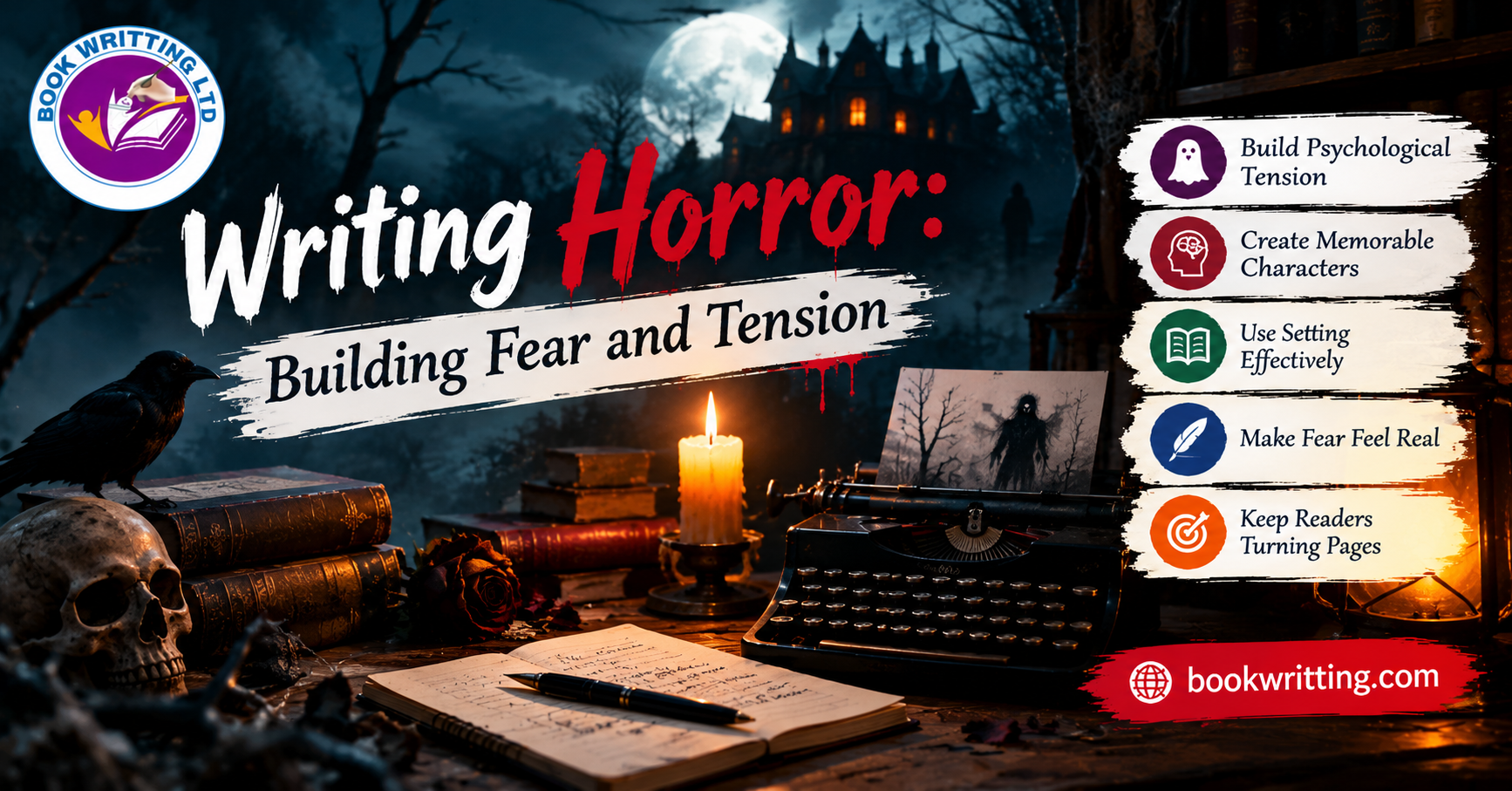
Writing Horror | Building Fear and Tension
12 October 2026 · 6 min read
Horror is one of the most powerful genres in storytelling because it taps into readers' fears, curiosity, and imagination. A successful horror story can make an ordinary setting feel unsettling, turn a simple mystery into a frightening experience, and keep readers wondering what will happen next. However, effective horror writing is not simply about frightening events. It is about creating anticipation, developing believable characters, and building tension that gradually intensifies.
Whether you're writing a supernatural ghost story, a psychological thriller, or a chilling tale about an isolated town, understanding how fear works can help you create a memorable reading experience. With thoughtful planning and strong storytelling techniques, you can keep readers engaged from the opening scene to the final page.
1. Understand What Makes Horror Effective
Fear is personal. Something that frightens one reader may not affect another in the same way. This is why successful horror often focuses on universal concerns, such as uncertainty, isolation, loss of control, or the unknown.
Instead of relying entirely on frightening events, consider what your characters fear most. A character who dreads being alone might find an empty house terrifying, while someone who values control might struggle when familiar surroundings begin behaving unpredictably.
Connecting fear to a character's personality gives the story emotional depth. Readers become more invested when they understand why a situation feels threatening.
2. Build Suspense Gradually
Suspense is one of the most important tools in horror writing. It encourages readers to anticipate danger without knowing exactly what will happen.
You can build suspense by introducing small, unexplained details before revealing the larger mystery. A strange sound from an empty room, a message that appears without explanation, or an unexpected change in a familiar place can raise questions and create uneasiness.
Avoid explaining every mysterious event immediately. Allow readers time to consider possible explanations. Carefully controlling what they know can make the eventual revelation more powerful.
The key is to make each new detail increase curiosity or uncertainty.
3. Create an Unsettling Setting
A strong horror setting does more than provide a location. It contributes to the atmosphere and influences the characters' behavior.
Consider settings such as:
An isolated farmhouse surrounded by fog
An abandoned hotel with a forgotten history
A quiet village where nobody discusses the past
A familiar home where small details seem out of place
A remote forest where directions become confusing
Use sensory details to make these environments feel real. Describe distant sounds, unusual silences, dim lighting, cold air, or the feeling of entering an unfamiliar space.
You do not need to describe everything. A few carefully chosen details can be more effective than lengthy descriptions.
4. Develop Believable Characters
Readers need someone to care about before they can fully invest in the danger surrounding them. Give your characters clear goals, personal weaknesses, meaningful relationships, and reasons to remain involved in the story.
A believable character will not always make the perfect decision. They may ignore a warning because they feel responsible for someone else, investigate a mystery because they need answers, or refuse to leave a place because it contains important memories.
These motivations make their actions understandable, even when their decisions create additional problems.
Strong character development also makes the consequences of the story more meaningful. The reader should care about what the characters stand to lose.
5. Use the Unknown Carefully
The unknown is a powerful source of horror because readers naturally try to explain unfamiliar events. Sometimes, the possibility of danger creates more suspense than a complete explanation.
Consider revealing a threat gradually. You might first introduce unusual sounds, then unexplained changes in the environment, and finally evidence that challenges the characters' understanding of what is happening.
However, mystery should not become confusion. Give readers enough information to follow the story while preserving questions that encourage them to continue reading.
A satisfying horror story eventually answers its most important questions, even if some uncertainty remains.
6. Control Pacing and Tension
Horror stories benefit from a balance between quiet moments and intense developments. If every scene is frightening, readers may become accustomed to the tension. If nothing significant happens for too long, the story may lose momentum.
Use quieter scenes to develop characters, establish normal routines, and introduce clues. Then gradually increase the pressure through discoveries, difficult choices, and unexpected complications.
Short sentences can emphasize urgency during tense moments, while longer passages can create a slower, more reflective atmosphere.
Chapter endings can also help maintain momentum. A surprising discovery, an unanswered question, or a change in a character's understanding can encourage readers to continue.
7. Make Every Revelation Matter
A surprising twist can be effective, but it should feel connected to the story rather than appearing without preparation.
Introduce subtle clues early enough that readers can recognize their significance later. These clues might involve a character's unusual reaction, a repeated symbol, an inconsistent account of an event, or a detail that seems unimportant at first.
When the truth emerges, readers should be able to look back and understand how the pieces fit together.
The strongest revelations change the reader's understanding of the characters, the setting, or the central mystery.
8. Avoid Common Horror Writing Mistakes
Some writing choices can weaken an otherwise promising horror story.
Watch out for these common problems:
Explaining every mystery too early
Depending entirely on sudden surprises
Making characters behave irrationally without a reason
Using familiar horror clichés without adding anything new
Including descriptions that do not contribute to atmosphere
Introducing twists that contradict earlier events
During revision, ask whether every frightening moment serves a purpose. Effective horror is built through atmosphere, character, pacing, and meaningful consequences—not simply through the number of frightening events.
9. Revise to Strengthen the Atmosphere
Once your first draft is complete, review it with a focus on suspense and clarity.
Look for scenes where tension disappears unnecessarily, clues are too obvious, or descriptions become repetitive. Check whether the characters' reactions feel believable and whether the central mystery develops at an appropriate pace.
Reading your work aloud can also help you identify awkward dialogue and sentences that interrupt the atmosphere.
If possible, ask a few readers to review the manuscript. Their reactions can show you which scenes create curiosity, which moments feel predictable, and where the story needs more explanation.
Writers who need help refining their manuscripts can explore the writing, editing, publishing, and book marketing services available through Book Writting Ltd.
Writing effective horror requires more than frightening situations. It involves understanding characters, creating unsettling environments, controlling suspense, and revealing information at the right moment.
By developing believable motivations, using the unknown carefully, balancing quiet scenes with intense moments, and revising thoughtfully, you can create a horror story that keeps readers interested throughout.
Remember that the most memorable horror stories do not simply present something frightening. They make readers care about the people experiencing it and wonder what might happen next.