How to Write a Book: Step-by-Step Guide for Beginners. create image
28 September 2026 · 9 min read
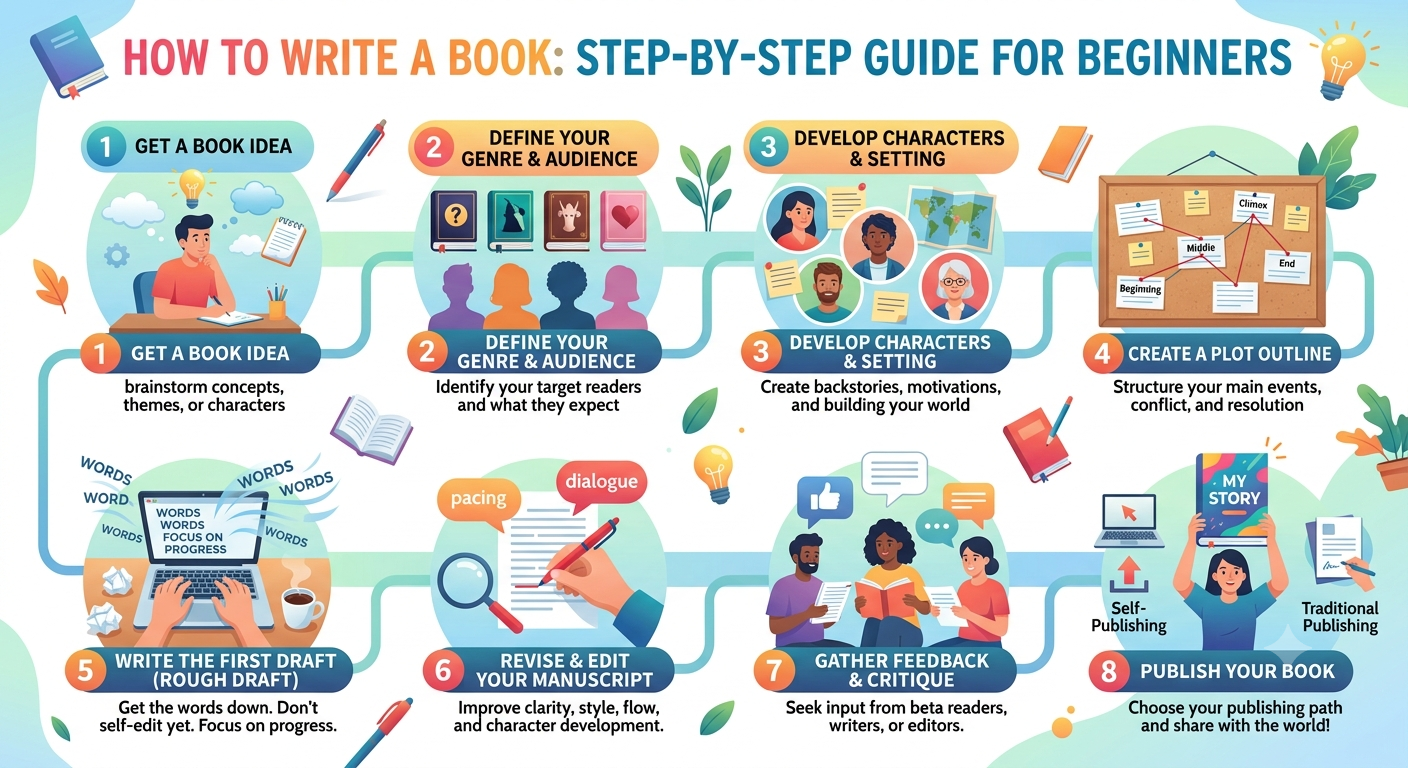
Have you ever wondered how to write a book but didn't know where to start? Writing a book may seem like a huge task, but breaking the process into manageable steps can make it much easier.
Whether you want to write a novel, memoir, self-help book, business book, or practical guide, you can turn your idea into a finished manuscript with the right plan, consistent writing, and careful editing.
This step-by-step guide to writing a book explains everything from developing your book idea and creating an outline to editing, formatting, publishing, and promoting your finished work.
How Do You Start Writing a Book?
The best way to start writing a book is to define your idea, identify your target reader, and create a basic outline before writing the first chapter.
Start by answering these questions:
What is my book about?
Who is going to read it?
What problem will it solve or what experience will it provide?
What makes my book useful, interesting, or different?
How many chapters will it have?
Once you have clear answers, you can begin building your manuscript.
Step 1: Choose Your Book Idea
Every book starts with an idea.
Your idea could come from your personal experience, professional knowledge, imagination, research, or a problem you want to help readers solve.
For example:
A personal experience can become a memoir.
Professional knowledge can become a business or educational book.
A fictional idea can become a novel.
A solution to a common problem can become a self-help guide.
Try to summarize your idea in one sentence. This simple exercise can help you stay focused throughout the writing process.
Step 2: Identify Your Target Audience
Knowing your readers is an important part of writing a successful book.
Think about:
Their age
Their interests
Their knowledge level
Their problems
Their goals
What they expect from your book
For example, a beginner's guide should use simple explanations and practical examples. A specialist book can use more technical language.
Tip: Write as though you are explaining the subject to one specific reader. This can make your writing more natural and engaging.
Step 3: Choose the Type of Book
Before creating your outline, decide what type of book you want to write.
Popular book categories include:
Book Type | Typical Focus |
|---|---|
Novel | Fictional story and characters |
Memoir | Personal experiences |
Self-Help | Advice and personal improvement |
Business | Strategies, knowledge, and professional insights |
Biography | Life of a person |
Cookbook | Recipes and cooking instructions |
Educational | Teaching a subject or skill |
Children's Book | Stories and learning for children |
Poetry | Poems and creative expression |
Your book's genre or category will influence its structure, tone, length, and writing style.
Step 4: Research Your Topic
If you are writing nonfiction, research is essential.
Collect information from reliable sources and organize your notes before writing. Research can help you:
Understand your subject
Find supporting evidence
Discover different perspectives
Identify information gaps
Create useful examples
Avoid factual errors
For fiction, research can help you create believable characters, locations, professions, historical settings, and situations.
Step 5: Create a Book Outline
A book outline is a roadmap for your manuscript.
You don't have to know every detail before you start. A simple chapter-by-chapter outline is enough to give your writing direction.
For example:
Introduction
Understanding the Problem
Common Challenges
Practical Solutions
Step-by-Step Strategies
Examples and Case Studies
Action Plan
Conclusion
For a novel, the structure might include the introduction of characters, the central conflict, rising action, climax, and resolution.
Step 6: Set a Writing Schedule
One of the biggest challenges in writing a book is staying consistent.
Instead of waiting for inspiration, create a writing routine.
You could aim for:
500 words per day
1,000 words per day
One chapter per week
30 minutes of writing each morning
The exact goal doesn't matter as much as consistency.
Even writing a small amount every day can eventually produce a complete manuscript.
Step 7: Write Your First Draft
Now it's time to write.
Don't worry about making every sentence perfect. Your first draft is about getting your ideas onto the page.
A useful rule is:
Write first. Edit later.
You may discover new ideas while writing. Your outline may change, and some chapters may move or disappear. That's a normal part of the writing process.
The goal of the first draft is simple: finish the manuscript.
Step 8: Develop Strong Chapters
Every chapter should have a clear purpose.
For nonfiction, a chapter might:
Explain an important concept
Solve a specific problem
Teach a skill
Provide an example
Present research
Give readers an action plan
For fiction, a chapter should move the story forward, develop characters, create conflict, reveal information, or build emotional interest.
Before finishing each chapter, ask:
“Does this chapter add something important to the book?”
Step 9: Revise Your First Draft
Once your first draft is finished, take a short break before revising it.
Then read the manuscript with a critical eye.
Look for:
Repeated information
Weak chapters
Missing explanations
Poor transitions
Unnecessary sections
Inconsistent ideas
Confusing sentences
Don't be afraid to remove material. Good writing is often about knowing what to leave out.
Step 10: Edit and Proofread Your Book
Editing and proofreading are different stages.
Developmental Editing
Focus on the overall structure, organization, content, and reader experience.
Line Editing
Improve sentence structure, word choice, clarity, tone, and flow.
Copy Editing
Check grammar, punctuation, spelling, consistency, and style.
Proofreading
The final stage focuses on small errors and formatting problems before publication.
If possible, have another person read your manuscript. A fresh reader can often find problems that the author misses.
Step 11: Create an Attractive Book Title
Your title should be memorable and relevant to your subject.
For nonfiction, a subtitle can explain the book's specific benefit.
For example:
How to Write a Book: A Step-by-Step Guide for Turning Your Idea Into a Finished Manuscript
A clear title helps readers immediately understand what they can expect.
Step 12: Design Your Book Cover
Your book cover is often the first visual impression readers have of your book.
A professional cover should:
Match the genre
Have readable typography
Use an appropriate visual concept
Avoid unnecessary clutter
Look good as a small thumbnail
Clearly display the title
The cover should communicate the tone and subject of the book at a glance.
Step 13: Format Your Book
Before publishing, your manuscript needs professional formatting.
Important elements include:
Page size
Margins
Fonts
Chapter headings
Paragraph spacing
Page numbers
Images
Tables
Table of contents
Print books and ebooks may require different formatting, so prepare each version according to its publishing requirements.
Step 14: Write Your Book Description
A strong book description should tell potential readers what the book is about and why it may be useful or interesting to them.
Focus on:
The main topic
The target reader
The problem or opportunity
The benefits
What readers can expect
Avoid giving away everything. The description should create enough interest for readers to want to learn more.
Step 15: Choose How to Publish Your Book
Authors generally have two main publishing routes.
Traditional Publishing
You submit your manuscript or book proposal to publishers, sometimes through a literary agent. If accepted, the publisher may handle some or most aspects of editing, production, distribution, and marketing according to the publishing agreement.
Self-Publishing
You manage the publishing process yourself or hire professionals for editing, design, formatting, and other services.
Self-publishing can give authors greater control over their work, but it also means taking responsibility for more parts of the publishing process.
Step 16: Promote Your Book
Publishing your book is only the beginning of reaching readers.
You can promote your book through:
Social media
Author websites
Email newsletters
Blog content
Book communities
Book clubs
Reviews
Interviews
Podcasts
Online advertising
Reader recommendations
Choose promotional channels that match your target audience and book category.
How Long Does It Take to Write a Book?
There is no fixed amount of time required to write a book.
The timeline depends on:
Book length
Genre
Research requirements
Writing speed
Editing process
Daily writing schedule
An author writing 500 words per day will progress differently from someone writing 2,000 words per day.
The important thing is to establish a realistic schedule and continue making progress.
How Many Words Should a Book Have?
Book length varies considerably by genre and purpose.
For example, a short practical guide may be much shorter than a detailed nonfiction book or novel. Instead of focusing only on word count, focus on whether the book provides a complete and satisfying experience for its intended readers.
What Are the Most Common Mistakes New Authors Make?
New writers often make a few common mistakes:
Starting without a clear idea.
Writing without an outline.
Trying to make the first draft perfect.
Failing to revise the manuscript.
Ignoring proofreading.
Writing for everyone instead of a specific audience.
Using unnecessary information.
Choosing a weak or confusing title.
Neglecting book cover design.
Giving up before finishing the manuscript.
Understanding these mistakes can help you approach the writing process more effectively.
Book-Writing Checklist
Before publishing your book, use this checklist:
Define the book idea
Identify the target audience
Choose the genre
Research the topic
Create an outline
Set a writing schedule
Complete the first draft
Revise the manuscript
Edit the content
Proofread the book
Choose a title
Design the cover
Format the interior
Write the book description
Choose a publishing method
Publish the book
Promote it to the right audience
Frequently Asked Questions About Writing a Book
Can anyone write a book?
Yes. You don't need to be a professional writer to begin. A clear idea, willingness to learn, consistent practice, and revision can help you develop a complete manuscript.
What should I write about?
Start with a subject you understand, care about, or are willing to research deeply. Consider what your target readers need, want, or are curious about.
Should I outline my book before writing?
An outline is highly useful because it gives you direction and helps organize your ideas. However, your outline can change as the manuscript develops.
Should I edit while writing?
For most writers, it is easier to complete a rough first draft before doing extensive editing. Constantly editing every sentence can slow your progress.
How do I publish my first book?
You can explore traditional publishing or self-publishing. Your choice will depend on how much control, support, and responsibility you want throughout the publishing process.
Final Thoughts
Learning how to write a book doesn't require completing everything at once. Start with one idea, turn that idea into an outline, write one chapter at a time, and gradually improve your manuscript through revision and editing.