Memoir vs. Autobiography | What’s the Difference?
30 September 2026 · 7 min read
If you want to write about your life, you may wonder whether your book should be called a memoir or an autobiography.
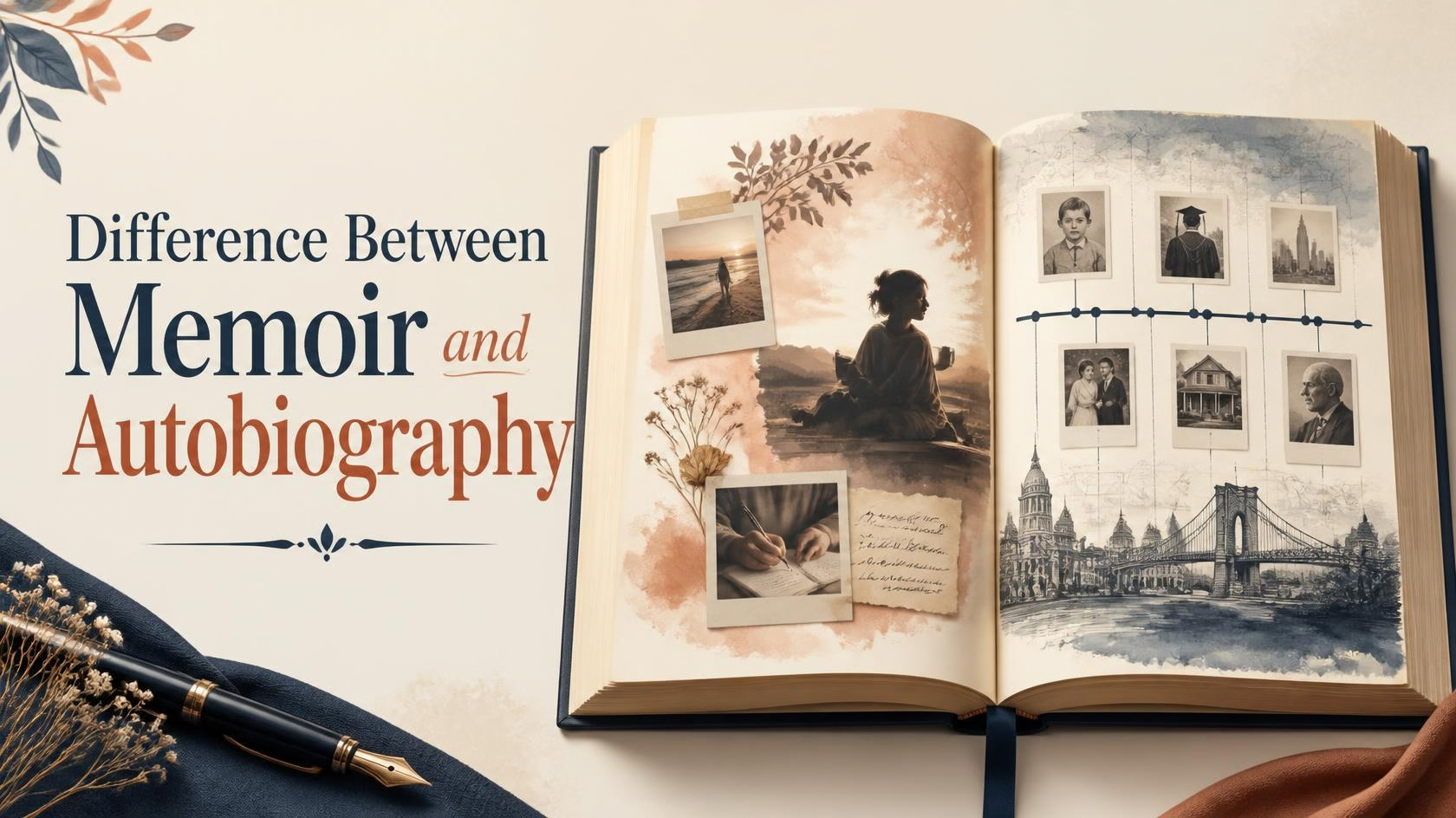
Although the two forms are closely related, they are not exactly the same. Both are generally first-person nonfiction accounts of the writer's own experiences, but they differ mainly in scope, focus, structure, and purpose.
Understanding the difference before you begin can help you plan your book more effectively.
What Is a Memoir?
A memoir is a nonfiction account centered on a particular period, theme, relationship, experience, or transformation in the author's life.
Rather than attempting to document everything that happened, memoir generally selects experiences that support a central story or idea.
For example, a memoir might focus on:
Growing up in a particular family
A major career change
An important relationship
Immigration or relocation
Overcoming a difficult period
A personal transformation
A significant journey
A particular stage of childhood or adulthood
Memoir often emphasizes reflection, meaning, emotion, and personal perspective.
Example
Imagine someone spent 60 years working in different industries.
An autobiography might describe the person's childhood, education, career, family, major achievements, and later life.
A memoir by the same person might focus specifically on the 10 years that transformed their career and changed how they viewed success.
The memoir does not need to tell everything.
It tells the part of the story that has a particular meaning.
What Is an Autobiography?
An autobiography is a nonfiction account of a person's life written by that person.
Traditionally, an autobiography aims to cover a much broader portion of the author's life, often beginning with childhood and progressing through major life events in roughly chronological order.
An autobiography may include:
Childhood
Family background
Education
Early experiences
Career
Relationships
Major achievements
Challenges
Important historical events
Personal development
Later life
The goal is generally to provide a broader record of the author's life rather than focusing on only one particular experience.
Memoir vs. Autobiography: Key Differences
Feature | Memoir | Autobiography |
|---|---|---|
Scope | A specific period, theme, or experience | A broad account of the author's life |
Focus | Meaning, reflection, and personal experience | Life events and development |
Structure | Can be thematic, chronological, or nonlinear | Usually chronological |
Subject | Selected parts of a life | Major portions or the whole life |
Style | Often personal and story-driven | Often documentary and chronological |
Purpose | Explore what an experience meant | Record the author's life story |
First Person | Usually | Usually |
Flexibility | High | More structured |
The distinction is primarily one of scope and emphasis, although real books can sometimes blur the boundaries between the two forms.
Memoir Focuses on a Story Within Your Life
One useful way to understand memoir is to think of it as a story within a life.
Your entire life may contain thousands of events, but a memoir selects experiences connected by a central idea.
For example:
Entire life:
Childhood → School → University → Career → Marriage → Family → Retirement
Memoir:
A five-year period during which the author changed careers and discovered a new purpose.
The memoir can go deeply into that selected experience without documenting every other part of the author's life.
Autobiography Focuses on the Larger Life Story
An autobiography generally takes a wider view.
It may begin with the author's early life and continue through important stages of development.
A basic structure could be:
Chapter 1: Childhood
Family, home, community, and early memories.
Chapter 2: Education
School experiences, teachers, friendships, and important lessons.
Chapter 3: Young Adulthood
Education, early work, relationships, and major decisions.
Chapter 4: Career
Professional development, opportunities, challenges, and achievements.
Chapter 5: Family and Personal Life
Relationships and important personal experiences.
Chapter 6: Challenges
Difficult periods and how they affected the author's life.
Chapter 7: Major Achievements
Important accomplishments and milestones.
Chapter 8: Reflection
Lessons, experiences, and perspective gained over time.
Which One Should You Write?
The answer depends on the story you want to tell.
A memoir may fit if you want to explore:
One powerful experience
A particular period of your life
A personal transformation
A specific relationship
A meaningful challenge
A central theme or lesson
An autobiography may fit if you want to document:
Your childhood through adulthood
Your complete career journey
Major events throughout your life
Your family and personal history
Your accomplishments and experiences
A broad record of your life
A simple question can help:
Do I want to tell my whole life story, or do I want to tell one important story from my life?
The first points toward autobiography; the second generally points toward memoir.
Can Anyone Write a Memoir or Autobiography?
Yes.
You do not have to be famous to write about your life.
Anyone with meaningful experiences, memories, relationships, challenges, lessons, or a story to preserve can write a personal nonfiction book.
A memoir can preserve an important experience for family members or reach readers who connect with the story's central theme.
An autobiography can create a lasting record of a person's broader life journey.
How to Start Writing a Memoir
Before writing your first chapter, identify the central story.
Ask yourself:
What experience do I want to explore?
Why is this experience important?
How did it change me?
What did I learn?
What emotions should readers experience?
Which memories are essential to the story?
What central theme connects the chapters?
Once you understand the central theme, you can select memories that support the story.
How to Start Writing an Autobiography
For an autobiography, begin by creating a timeline of your life.
Write down important events such as:
Birth and early childhood
Family experiences
School
Education
First job
Career milestones
Important relationships
Major achievements
Difficult periods
Important decisions
Travel and relocation
Family milestones
Later-life experiences
Then organize those events into chapters.
A chronological structure can make a long life story easier for readers to follow.
Memoir and Autobiography Writing Tips
1. Be Specific
Specific memories make personal writing more vivid.
Instead of simply saying:
"My childhood was difficult."
Describe the people, places, events, conversations, and moments that demonstrate why it was difficult.
2. Include Reflection
Don't only explain what happened.
Consider what the experience meant to you and how it changed your perspective.
3. Develop a Strong Voice
Your personal voice is an important part of life writing.
Write in a way that sounds authentic to you.
4. Use Scenes
Where appropriate, bring important moments to life through setting, dialogue, actions, thoughts, and sensory details.
5. Organize Your Material
Whether you're writing a memoir or autobiography, an outline can prevent your manuscript from becoming a collection of disconnected memories.
6. Revise Carefully
A first draft is only the beginning.
Revision can improve structure, clarity, pacing, consistency, and readability.
Memoir vs. Autobiography vs. Biography
These terms are sometimes confused.
Memoir
Your own life experiences, usually focused on a particular theme, period, or story.
Autobiography
Your own broader life story, generally written by you and often organized chronologically.
Biography
Another person writes about someone else's life.
The key difference between autobiography and biography is who writes the story.
Frequently Asked Questions
Is a memoir the same as an autobiography?
No. They are closely related, but a memoir generally focuses on a specific period, theme, or experience, while an autobiography generally provides a broader account of the author's life.
Is a memoir always written in chronological order?
No. Memoirs can use chronological, thematic, nonlinear, or other structures depending on the story.
Does an autobiography have to cover an entire life?
Traditionally, an autobiography aims to cover a broad portion of the author's life, often from childhood through the time of writing. The boundaries can vary in actual publishing practice.
Can I write a memoir if I'm not famous?
Yes. Memoir is not limited to famous people. A focused and meaningful personal story can be written by anyone.
Which is easier to write: memoir or autobiography?
The workload depends on the scope of the project. A memoir's narrower focus can limit the amount of life material that needs to be covered, while an autobiography generally requires a broader account of the author's experiences.
Can a book contain elements of both?
Yes. The boundaries between memoir and autobiography are not always rigid, and some life-writing books combine broad biographical coverage with a strong thematic or reflective focus.
The main difference between a memoir and an autobiography is scope and focus.
A memoir explores a meaningful part of your life, often through a particular theme, period, or transformation.
An autobiography provides a broader account of your life and is commonly structured around the sequence of major life events.
Before you begin writing, decide whether your goal is to explore one important story or document the larger journey of your life.
Once you know the purpose, choosing the right format and creating your outline becomes much easier.
Ready to turn your life story into a book? Explore writing and publishing resources at Book Writting.