What’s the Average Word Count for a Novel? A Complete Guide by Genre
28 September 2026 · 5 min read
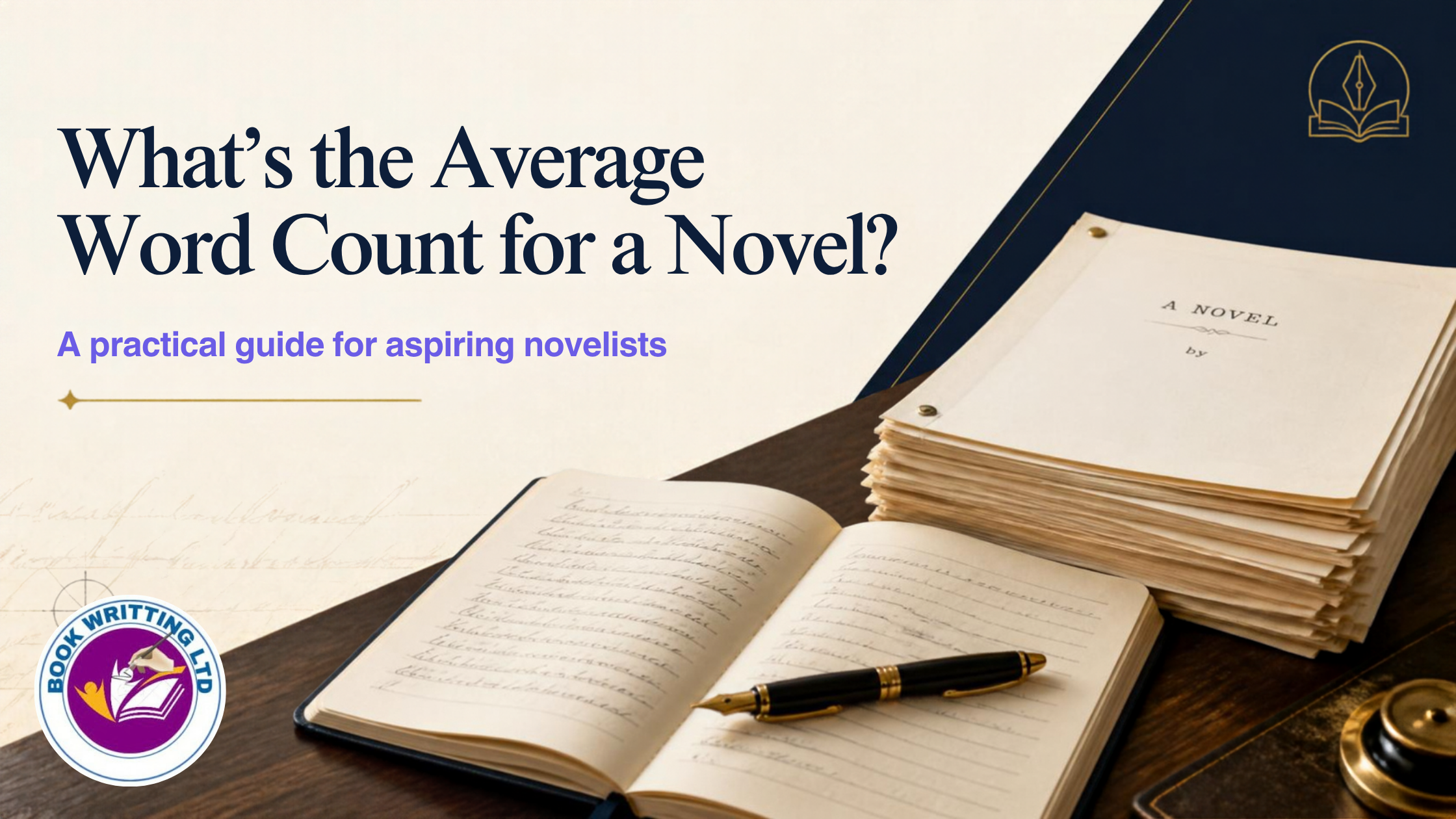
If you are writing your first novel, one of the questions you may ask is: How many words should a novel be?
There is no single word count that works for every novel. The appropriate length depends on factors such as genre, target audience, story complexity, publishing format, and the expectations of readers and publishers.
As a general guideline, many adult novels fall somewhere around 70,000 to 100,000 words, although plenty of successful books fall outside that range. Reedsy similarly identifies 70,000–100,000 words as a typical range for a standard novel and emphasizes that genre plays an important role.
So, rather than trying to hit one magic number, writers should understand the usual expectations for their particular type of book.
What Is Considered a Novel?
There is not one universal word-count definition of a novel.
For example, the Science Fiction and Fantasy Writers Association currently defines a novel for Nebula Award purposes as a work of 40,000 words or more.
Publishing and querying conventions can be different. Writer's Digest has noted that first-time novelists are often advised to aim around 80,000–100,000 words, while acknowledging that novels can vary substantially in length.
This distinction is important: a manuscript can technically qualify as a novel while still being shorter or longer than the typical length expected in its particular publishing market.
Average Novel Word Count by Genre
Genre is one of the biggest factors affecting the appropriate length of a novel.
Genre | Typical Word Count |
|---|---|
Literary Fiction | 80,000–100,000 |
Romance | 80,000–100,000 |
Mystery & Thriller | 80,000–100,000 |
Horror | 70,000–100,000 |
Fantasy | 100,000–115,000 |
Science Fiction | 100,000–115,000 |
Young Adult | 55,000–80,000 |
Middle Grade | 20,000–55,000 |
Nonfiction | 50,000–80,000 |
These are useful planning ranges rather than strict requirements. Reedsy's current guide gives similar genre-based ranges and notes that fantasy and science fiction often run longer because of worldbuilding, while YA and middle-grade books tend to be shorter.
Literary and Commercial Fiction
For many adult literary and commercial novels, 80,000–100,000 words is a practical range.
These stories often need enough space for character development, relationships, themes, conflicts, and satisfying resolution without allowing the narrative to become unnecessarily long.
A shorter literary novel can still work if the story and structure support it. Likewise, some novels require additional length because of multiple characters, timelines, or complex plots.
Romance Novels
Romance commonly falls around 80,000–100,000 words, although the exact target can vary considerably by subgenre and publishing format.
Because romance generally focuses strongly on character relationships and emotional development, pacing is important. Every chapter should contribute to the central relationship, character arc, or major conflict.
Mystery and Thriller Novels
Mystery and thriller novels commonly fall around 80,000–100,000 words.
These genres depend heavily on pacing, clues, suspense, investigation, and plot progression. A longer manuscript is not automatically better if additional scenes slow down the mystery.
Writers should focus on maintaining tension and ensuring that each major scene contributes to the story.
Fantasy and Science Fiction
Fantasy and science fiction often require more words because writers may need to establish fictional worlds, cultures, technology, magic systems, political structures, and complex histories.
Reedsy's current guide places many fantasy and science-fiction novels around 100,000–115,000 words, while noting that some fantasy series can go considerably longer.
However, worldbuilding should serve the story. Adding pages simply to make a fantasy novel longer can create unnecessary pacing problems.
Young Adult and Middle Grade
Young adult novels are generally shorter than many adult novels. A common range is around 55,000–80,000 words, although fantasy and other complex YA subgenres can run longer.
Middle-grade fiction is usually shorter still, commonly falling somewhere between 20,000 and 55,000 words, depending on the reader's age and genre.
The intended reading age matters because younger readers have different expectations for pacing, structure, vocabulary, and reading stamina.
Does a Longer Novel Mean a Better Novel?
Not necessarily.
A 120,000-word novel is not automatically more valuable than an 80,000-word novel. What matters is whether the length supports the story.
If a manuscript contains repeated scenes, unnecessary descriptions, weak subplots, or dialogue that does not move the story forward, reducing the word count may improve the reading experience.
On the other hand, cutting important character development or rushing the ending simply to reach a lower target can also hurt the manuscript.
The goal should be the right length for the story—not the highest possible word count.
How Many Pages Is a 90,000-Word Novel?
Word count and page count are not exactly the same because formatting, font size, trim size, spacing, and typography all affect the final number of pages.
For a standard manuscript, Reedsy estimates approximately four double-spaced manuscript pages per 1,000 words. Using that calculation, 90,000 words would be roughly 360 double-spaced manuscript pages.
A finished printed book can have a very different page count because publishers use different layouts and page sizes.
Should New Writers Follow Word-Count Guidelines?
If you are preparing a manuscript for traditional publishing, understanding genre expectations can be useful.
Reedsy's publishing guidance notes that most debut novels tend to fall around 80,000–100,000 words, while some genres have different expectations.
However, these numbers should be treated as guidelines rather than rigid rules.
If your first draft is 95,000 words, you do not necessarily need to make it exactly 90,000. Likewise, if your finished manuscript is 105,000 words, cutting 15,000 words without a structural reason may not improve it.
Instead, examine your manuscript for pacing, repetition, unnecessary scenes, missing development, and overall story structure.
So, what's the average word count for a novel?
For many adult novels, 70,000–100,000 words is a useful general range. However, the ideal length depends heavily on genre and audience. Fantasy and science fiction often run longer, while YA and middle-grade fiction generally have shorter word-count expectations.
The most important thing is to tell the story effectively. Use genre word-count ranges as a planning tool, but do not allow an arbitrary number to control your entire writing process.
Write the story that needs to be written, revise it carefully, and then use word count as one way to evaluate whether the finished manuscript fits its intended genre and audience.
The right novel length is not simply about reaching a number—it is about giving your story enough space to become complete, engaging, and satisfying.