How to Write a Book | A Complete Beginner’s Guide
4 September 2026 · 10 min read
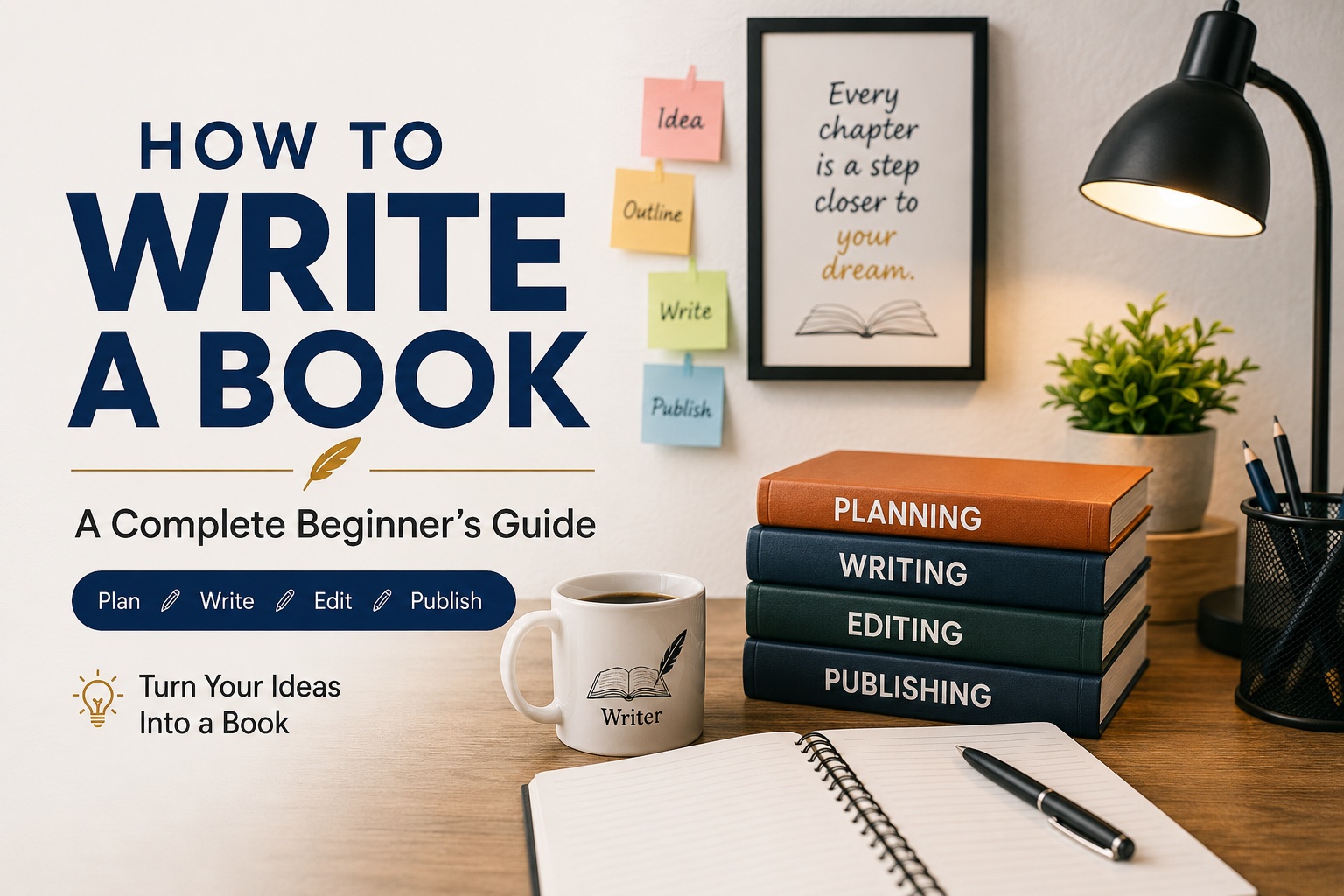
How to Write a Book: A Complete Beginner’s Guide
Have you ever had an idea for a book but didn’t know where to begin?
You may have a story in your head, valuable knowledge to share, or a personal experience that you believe could help other people. Turning that idea into a finished book can feel overwhelming, especially if you have never written a book before.
The good news is that you don't need to know everything before you start.
Writing a book is a process. With the right plan, consistent effort, and willingness to revise your work, you can turn your initial idea into a complete manuscript.
In this beginner's guide, we'll explain how to write a book step by step—from developing your idea and creating an outline to writing, editing, and preparing your manuscript for publication.
1. Start With a Clear Book Idea
Every book begins with an idea.
Before you start writing hundreds of pages, take some time to understand exactly what you want your book to be about.
Ask yourself:
What is my book about?
Who is going to read it?
What do I want readers to learn, experience, or feel?
Why am I the right person to write this book?
What makes my idea different or interesting?
Your idea doesn't need to be completely original. Many successful books explore familiar subjects but present them from a fresh perspective.
For example, instead of simply writing a book about productivity, you could focus on productivity for busy parents, students, entrepreneurs, or remote workers.
The more specific your idea becomes, the easier it will be to plan your book.
2. Decide What Type of Book You Want to Write
The next step is deciding what kind of book you want to create.
Some common categories include:
Fiction
Romance
Mystery
Thriller
Science fiction
Fantasy
Biography
Memoir
Self-help
Business
Personal development
Educational books
Children's books
Cookbooks
Your genre or category will influence your writing style, structure, audience, and even the length of your book.
If you're writing fiction, you'll usually need to develop characters, conflict, setting, and a storyline.
For nonfiction, you'll generally focus more on research, information, examples, explanations, and practical advice.
3. Know Your Target Reader
One of the biggest mistakes new writers make is trying to write for everyone.
Instead, identify your ideal reader.
Think about:
Their age
Their interests
Their problems
Their goals
Their knowledge level
What they expect from your type of book
Understanding your reader makes it easier to decide what information to include and how you should communicate it.
For example, a book written for teenagers will likely use a different vocabulary and tone than a professional business book.
When you know your audience, your writing becomes more focused and purposeful.
4. Create a Simple Book Outline
You don't necessarily need a perfect outline, but having a basic structure can make writing much easier.
Start by dividing your book into chapters.
For example:
Chapter 1: Introduction
Introduce the topic, character, problem, or central idea.
Chapter 2: The Beginning
Develop the story or introduce important concepts.
Chapter 3: The Main Challenge
Present the main conflict, problem, or major topic.
Chapter 4: Development
Explore the subject or storyline in greater detail.
Chapter 5: Solutions or Turning Point
Provide an important development, discovery, or change.
Final Chapter: Conclusion
Bring the story or discussion to a satisfying conclusion.
Your actual structure will depend on the type of book you're writing, but an outline gives you a roadmap to follow.
5. Set a Realistic Writing Schedule
One of the hardest parts of writing a book isn't knowing what to write—it's staying consistent.
You don't have to write an entire book in a week.
Instead, create a realistic schedule.
For example, you might decide to:
Write 500 words per day
Write for 30 minutes every morning
Complete one chapter each week
Write every weekday
Spend weekends reviewing your work
Consistency matters more than trying to produce huge amounts of content in a single session.
Even 300 words a day can eventually become a complete manuscript.
The key is to keep moving forward.
6. Choose a Comfortable Writing Environment
Your environment can have a major effect on your productivity.
Some writers prefer complete silence, while others enjoy background music or a coffee shop atmosphere.
Create a writing space where you can concentrate.
Keep your essential tools nearby, such as:
Computer or laptop
Notebook
Research materials
Headphones
Writing software
Reference books
Most importantly, reduce distractions.
Turn off unnecessary notifications and avoid constantly checking social media while you're writing.
Your goal is to create a period of uninterrupted focus.
7. Write the First Draft Without Trying to Make It Perfect
This is one of the most important lessons for new authors.
Your first draft does not need to be perfect.
In fact, trying to make every sentence perfect while writing your first draft can slow you down considerably.
Instead, focus on getting your ideas onto the page.
You can fix:
Grammar
Spelling
Sentence structure
Repetition
Weak descriptions
Unnecessary sections
during the editing stage.
Think of the first draft as the foundation of your book.
You can improve the foundation later.
8. Keep Your Writing Consistent
Consistency isn't only about your writing schedule.
Your book should also maintain a consistent voice and style.
Pay attention to:
Tone
Vocabulary
Point of view
Character behavior
Chapter structure
Formatting
Terminology
For fiction writers, characters should generally behave in ways that make sense based on their personalities and development.
For nonfiction writers, explanations should remain clear and easy to follow.
Consistency makes a book feel professional.
9. Research When Necessary
Depending on your topic, research may be an important part of the writing process.
Research can help you:
Understand your subject
Verify information
Find examples
Discover different perspectives
Avoid inaccurate claims
Add credibility to your book
Keep track of your research sources as you work.
Don't wait until the end of the project to remember where you found important information.
For nonfiction books especially, accurate research can significantly improve the quality and credibility of your manuscript.
10. Finish Your First Draft
Many people start writing books.
Far fewer actually finish them.
That's why completing your first draft is such an important milestone.
Don't worry if the manuscript isn't perfect.
Your goal at this stage is simply to reach the end.
Once you have a complete draft, you can finally see the entire book as one piece.
You can then identify:
Missing information
Weak chapters
Repetitive sections
Plot problems
Structural issues
Areas that need more detail
Finishing gives you something concrete to improve.
11. Take a Break Before Editing
Once you finish your first draft, consider taking some time away from the manuscript.
Even a short break can help you return with fresh eyes.
When you've been working on the same document for weeks or months, you can become too familiar with the text to notice problems.
After taking a break, read your manuscript again.
You may immediately notice sections that need rewriting or chapters that don't work as well as you originally thought.
That's completely normal.
Editing is where your book begins to take shape.
12. Edit Your Manuscript
Editing is one of the most important stages of writing a book.
Start with the big picture before worrying about individual sentences.
Look at:
Overall structure
Chapter order
Pacing
Repetition
Missing information
Unnecessary sections
Weak arguments
Character development
Once the structure works, move to sentence-level editing.
Look for:
Grammar mistakes
Spelling errors
Awkward sentences
Repeated words
Unclear explanations
Formatting problems
A professional editor can also provide valuable feedback and help identify problems you may not notice yourself.
13. Get Feedback From Other Readers
Before publishing, consider giving your manuscript to a few trusted readers.
Ask them specific questions.
For example:
Was the book easy to understand?
Which section did you enjoy most?
Where did you lose interest?
Was anything confusing?
Did the ending feel satisfying?
What would you improve?
Don't be afraid of constructive criticism.
Feedback isn't an attack on your writing.
It's an opportunity to make the book stronger.
14. Choose a Strong Book Title
Your title is one of the first things potential readers will see.
A good title should be:
Easy to remember
Relevant to the book
Appropriate for the target audience
Clear
Interesting
For nonfiction, a descriptive title can immediately communicate the book's benefit.
For fiction, you have more creative freedom, but the title should still fit the genre and tone.
You should also consider how the title will look on a book cover, website, online bookstore, and social media post.
15. Create a Professional Book Cover
People often say not to judge a book by its cover, but readers frequently use the cover to decide whether to investigate a book further.
A professional cover should communicate the book's genre and overall tone.
Consider:
Typography
Images
Colors
Layout
Genre expectations
Readability at thumbnail size
Your cover should look good both as a physical book and as a small digital image.
16. Prepare Your Manuscript for Publishing
Before publishing, your manuscript may need professional formatting.
This can include:
Page layout
Chapter headings
Paragraph spacing
Fonts
Margins
Page numbers
Table of contents
Front matter
Back matter
eBook formatting
Different publishing formats may have different requirements.
A print book and an eBook, for example, don't always use the same formatting approach.
17. Decide How You Want to Publish
Once your manuscript is complete, you'll need to decide how you want to publish it.
Some authors choose traditional publishing.
Others prefer self-publishing because it can give them more control over the publishing process.
You may also choose to publish digitally, in print, or in multiple formats.
Before making your decision, consider:
Your goals
Budget
Timeline
Desired level of control
Marketing responsibilities
Distribution
Target readers
There isn't one perfect publishing path for every author.
18. Don't Forget Book Marketing
Writing and publishing a book are only part of the journey.
You also need to help potential readers discover it.
Depending on your audience, book marketing may include:
Social media
Author websites
Blog content
Email marketing
Book reviews
Online communities
Promotional campaigns
Interviews
Author events
Advertising
Start thinking about marketing before your book is published.
Building an audience early can make the launch process easier.
19. Consider Professional Help
You don't have to do every part of the publishing process alone.
Professional assistance can be useful if you need help with:
Book writing
Ghostwriting
Editing
Proofreading
Book formatting
Publishing
Book marketing
Audiobook production
Getting professional help doesn't make you less of an author.
Your idea and vision remain yours. Professional support can simply help you turn that vision into a polished final product.
20. Keep Going
Writing a book requires patience.
There will probably be days when you don't feel motivated. You may question your idea or think your manuscript isn't good enough.
That's part of the process.
Instead of waiting for inspiration, create a routine and keep working.
Your first draft may not look like the book you imagined.
That's okay.
Books are developed through writing, rewriting, editing, and refinement.
The most important step is to begin.
Final Thoughts
Learning how to write a book can seem difficult when you're looking at the entire project at once.
Instead, break the process into smaller steps.
Start with an idea.
Understand your reader.
Create an outline.
Write your first draft.
Edit and improve it.
Get feedback.
Prepare the manuscript.
Then choose the publishing path that best fits your goals.
You don't need to have everything figured out before you start writing.
You simply need an idea, a plan, and the commitment to keep moving forward.
Your book begins with the first page.
Ready to turn your book idea into reality? BookWritting.com can help you move from an idea or unfinished manuscript toward a professionally prepared book.