
Writing Horror That Hooks: Creating Suspense and Fear
5 November 2026 · 7 min read
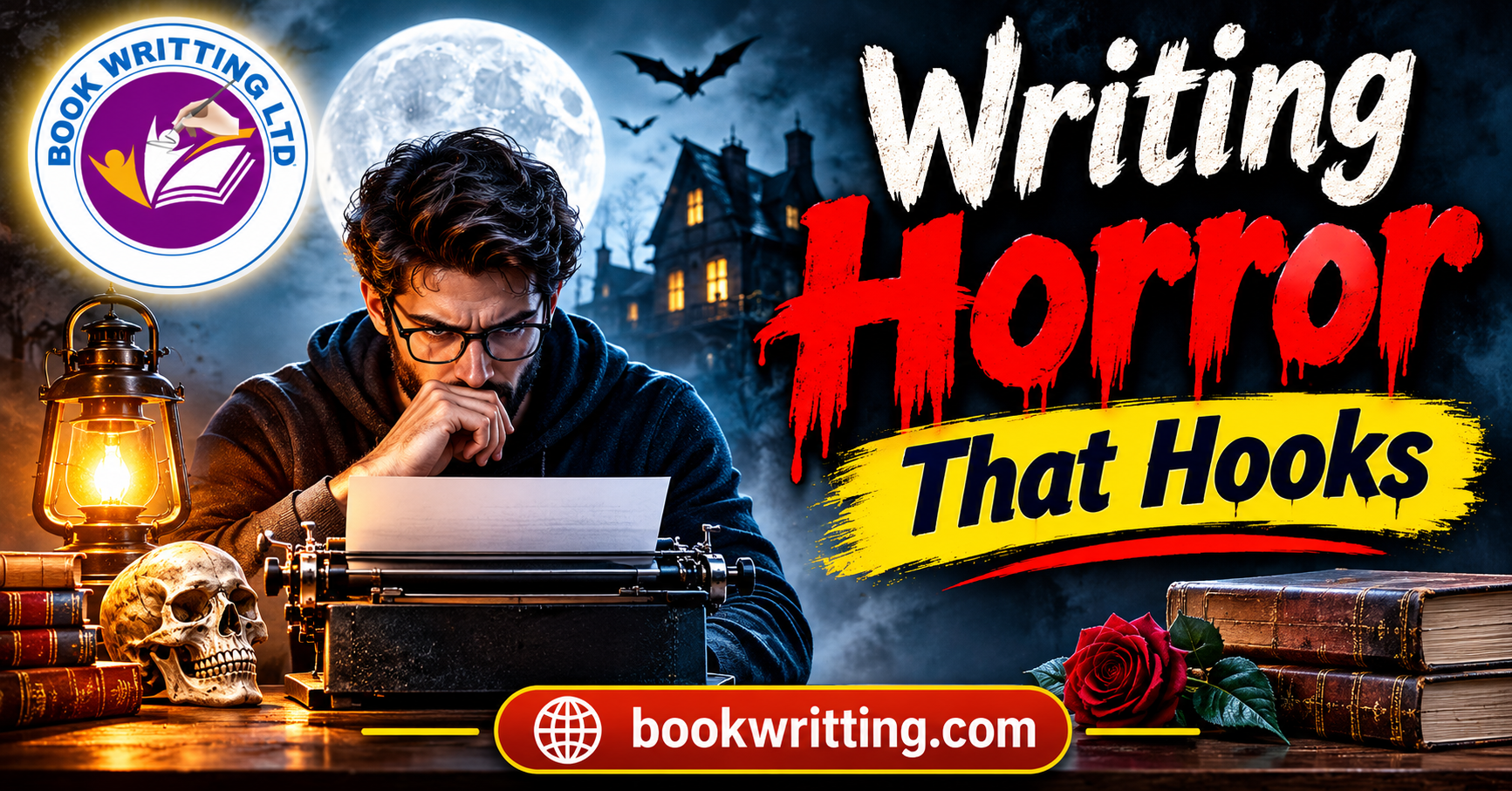
Horror fiction has a unique ability to capture readers' attention by making ordinary situations feel mysterious, unsettling, and unpredictable. A quiet house, an unfamiliar sound, or an unexpected discovery can become the beginning of an unforgettable story.
However, writing effective horror involves much more than introducing frightening characters or unusual events. A compelling horror story depends on suspense, atmosphere, believable characters, psychological tension, and carefully controlled revelations.
The goal is to make readers curious about what might happen next while encouraging them to become emotionally invested in the characters.
Whether you're writing a supernatural mystery, psychological thriller, ghost story, or gothic horror novel, the right storytelling techniques can help you create a memorable experience.
Here are practical techniques for writing horror stories that keep readers interested from the opening page to the final revelation.
1. Start with a Powerful Opening Hook
The beginning of a horror story should give readers a reason to continue.
You can introduce an unusual event, an unanswered question, a strange discovery, or a situation that immediately creates uncertainty.
For example, imagine a character returning to an abandoned family house and discovering that an old clock is running despite having no working mechanism.
The situation creates curiosity without explaining everything immediately.
Your opening does not need to reveal the central mystery. Instead, introduce something interesting that makes readers ask questions.
Avoid relying entirely on sudden surprises. A thoughtful opening that gradually creates uncertainty can be just as effective.
2. Create an Atmosphere of Mystery
Atmosphere is one of the most important elements of horror writing. It helps establish the emotional environment of the story and influences how readers interpret ordinary events.
An isolated village, an unfamiliar building, an empty railway station, or a quiet forest can provide an effective setting.
However, the location itself does not need to be frightening. A familiar home or cheerful neighborhood can become mysterious when something unexpected disrupts its normal routine.
Use sensory details carefully. The sound of an old door moving, the distant noise of footsteps, or an unusual silence can create tension without lengthy explanations.
Choose descriptions that support the scene rather than overwhelming it.
A memorable atmosphere allows readers to imagine what might be happening beyond what the characters can immediately understand.
3. Develop Believable and Relatable Characters
Readers become more invested in horror stories when they care about the characters experiencing the mysterious events.
Give your protagonist understandable goals, personal responsibilities, strengths, and weaknesses.
Your main character might be a journalist investigating an unusual event, a student researching an abandoned building, or a family member trying to understand an unexplained mystery.
Consider what makes each character react differently.
One person might approach an unusual situation logically, while another may become curious or suspicious. These different reactions create natural conversations and conflicts.
Avoid making characters behave irrationally simply to move the plot forward. Their decisions should make sense based on their knowledge, personality, and circumstances.
4. Use Psychological Suspense
Psychological suspense focuses on uncertainty, perception, and what characters believe may be happening.
Sometimes the possibility of an unexplained event creates more tension than showing its complete explanation.
A character might notice that familiar objects have changed position, receive an unexpected message, or repeatedly encounter a location that seems different each time.
Readers begin questioning what is happening and whether the character understands the situation correctly.
Allow the uncertainty to develop gradually. Introduce clues, conflicting explanations, and moments that challenge earlier assumptions.
You do not need to explain every mysterious detail immediately. Carefully controlled uncertainty can keep readers interested throughout the story.
5. Choose the Right Setting for Your Horror Story
A well-developed setting can become an important part of the horror experience.
Think about how the location influences the characters and the events around them.
Possible settings include:
An abandoned historical building.
A remote coastal village.
An old family estate.
A mysterious library.
A quiet countryside town.
An unfamiliar apartment building.
A forest surrounded by local legends.
Consider the history of your setting. Perhaps an important event occurred there years earlier, or the community has a tradition that outsiders do not understand.
Give the location a distinctive personality through architecture, atmosphere, sounds, lighting, and historical details.
When the setting contributes to the mystery, it becomes more than a background for the story.
6. Build Suspense Through Pacing
Pacing determines how quickly information and events unfold.
In horror fiction, effective pacing often involves alternating quieter moments with important discoveries and unexpected developments.
A story that constantly introduces dramatic events may leave readers with little time to become emotionally invested. On the other hand, a story that moves too slowly may lose its momentum.
Consider using a gradual structure.
Begin with ordinary circumstances, introduce an unusual detail, allow the mystery to develop, and gradually increase the importance of the characters' discoveries.
Shorter sentences can create urgency during important moments, while longer descriptive passages can establish atmosphere.
The goal is to control information so readers remain curious about what will happen next.
7. Introduce Unexpected Twists and Revelations
An effective twist can change how readers understand everything that happened earlier in the story.
Perhaps a character discovers that an apparently unrelated event is connected to the central mystery. An old document might reveal an unexpected family connection, or a trusted character may know more than they initially admitted.
However, twists should feel earned.
Plant clues throughout the story so readers can recognize their importance after the revelation.
Avoid introducing completely unrelated information at the last moment simply to surprise the audience.
A satisfying twist should deepen the story, reveal something meaningful about a character, or provide a new understanding of the central mystery.
8. Use Dialogue to Strengthen Tension
Dialogue can communicate fear, uncertainty, suspicion, and disagreement without lengthy narration.
Characters may question each other's observations, disagree about what they have discovered, or hesitate before discussing an uncomfortable subject.
Use conversations to reveal information gradually.
For example, a character might mention an unusual experience, only for another character to recognize a detail that makes the situation more complicated.
Avoid making every conversation overly dramatic. Natural dialogue often creates a stronger sense of realism.
Give different characters recognizable speaking styles and allow their reactions to reflect their personalities.
9. Avoid Common Horror Writing Mistakes
Even an interesting horror concept can become less effective when the storytelling relies on predictable patterns.
Watch out for these common mistakes:
Explaining every mystery: Preserve some uncertainty where it strengthens the atmosphere.
Using too many unexpected events: Allow important moments enough time to develop.
Creating unrealistic characters: Make decisions believable and consistent with their personalities.
Relying on clichés: Look for fresh ways to approach familiar horror themes.
Ignoring the setting: Make the location contribute to the mystery.
Revealing twists without clues: Give readers opportunities to recognize important details.
Using unnecessary descriptions: Keep scenes focused and purposeful.
The strongest horror stories often rely on careful storytelling rather than constant surprises.
10. Revise Your Horror Manuscript
After completing your first draft, review the manuscript for atmosphere, pacing, character development, and continuity.
Ask yourself whether the opening creates curiosity, the characters behave convincingly, and the central mystery develops naturally.
Check whether clues appear in the right places and whether the final revelation connects with earlier events.
Pay attention to repetitive descriptions, unnecessary dialogue, and scenes that interrupt the story's momentum.
Feedback from trusted readers can help you understand which moments create curiosity and where the story may need stronger development.
If you need assistance refining your manuscript or preparing it for publication, explore writing, editing, proofreading, publishing, and book marketing services through Book Writting Ltd.
Writing horror that hooks readers requires a thoughtful combination of atmosphere, suspense, psychology, character development, and unexpected discoveries.
Begin with an intriguing idea, create a memorable setting, and develop believable characters whose experiences matter to readers. Build tension gradually, use dialogue effectively, and introduce revelations that reward curiosity.
Remember that effective horror does not depend entirely on frightening events. Sometimes an unanswered question, an unusual detail, or the possibility of something unexpected can create a stronger impression.
When mystery, atmosphere, and storytelling work together, your horror story can keep readers curious long after they reach the final page.