How Many Pages Is an Average Novel?
16 October 2026 · 7 min read
If you're planning to write a novel, one of the first questions you might ask is how many pages it should contain. Perhaps you're outlining your first story, preparing a manuscript for publication, or wondering whether your current draft is long enough.
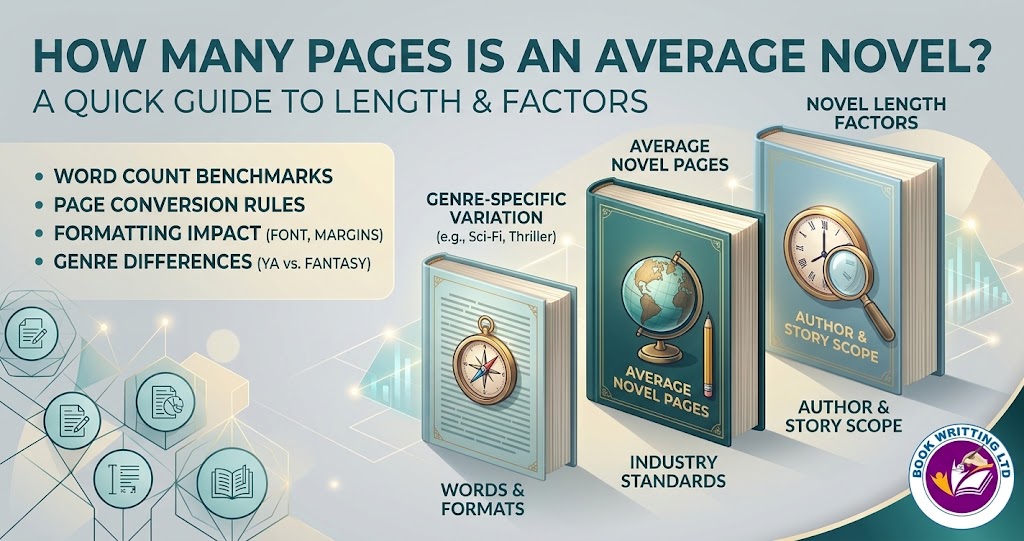
The answer depends on several factors, including genre, word count, formatting, font size, and page dimensions. A novel with 80,000 words might produce a very different page count in a printed paperback than in a manuscript document.
Although there is no universal page count for every novel, understanding typical word counts and publishing conventions can help you set realistic writing goals.
In this guide, we'll explore the average length of a novel, compare different genres, and explain how to estimate the number of pages your manuscript might need.
1. How Many Pages Does an Average Novel Have?
A typical adult novel often contains approximately 70,000–100,000 words. Depending on the book's trim size, font, spacing, and layout, this might translate to roughly 250–400 printed pages.
This is a general estimate, not a strict publishing rule. Some novels are considerably shorter, while others extend beyond 500 pages.
For example, an 80,000-word novel might occupy around 300 pages in a common paperback format. The same manuscript could produce a different page count if the publisher uses a larger font, wider margins, or a different page size.
For writers, word count is generally a more reliable measure of manuscript length than page count because page formatting can change throughout the publishing process.
2. Average Novel Length by Genre
Different genres have different storytelling conventions. Some require more space for world-building and complex plots, while others emphasize concise storytelling and a focused narrative.
The following ranges are approximate planning guidelines rather than fixed industry requirements.
Novel Genre | Typical Word Count | Approximate Printed Pages |
|---|---|---|
Young adult | 50,000–80,000 | 180–320 |
Romance | 50,000–90,000 | 180–360 |
Mystery and crime | 70,000–100,000 | 250–400 |
Thriller | 70,000–100,000 | 250–400 |
Literary fiction | 70,000–100,000 | 250–400 |
Science fiction | 80,000–120,000 | 300–480 |
Fantasy | 90,000–130,000 | 330–520 |
Novella | 20,000–40,000 | 70–160 |
Page estimates assume a typical paperback layout and can vary substantially. Genre conventions also differ by age category, publisher, and market.
Use these figures as a starting point when planning your manuscript. Always check the submission guidelines of your intended publisher or literary agent if you're preparing a book for professional consideration.
3. How Word Count Affects Page Count
Word count is one of the most important factors influencing the final length of a novel.
A simple planning estimate for a printed book is approximately 250–300 words per page, although actual page density varies.
Here is a rough illustration:
Word Count | Estimated Printed Pages |
|---|---|
40,000 words | 130–160 pages |
60,000 words | 200–240 pages |
80,000 words | 270–320 pages |
100,000 words | 330–400 pages |
120,000 words | 400–480 pages |
These figures are estimates, not exact conversions. Dialogue-heavy novels may have more paragraph breaks and fewer words per page. Books with illustrations, chapter-opening pages, or additional front matter may also have more pages.
If you are still drafting your novel, concentrate on completing a coherent story rather than trying to reach a particular printed page count.
4. What Factors Influence a Novel's Page Count?
Two novels with the same number of words can have noticeably different page counts. Several publishing choices explain why.
Book Size
A larger paperback can accommodate more text on each page than a smaller edition using comparable typography. Smaller books may therefore need more pages for the same manuscript.
Font and Font Size
Larger fonts generally require more space. Publishers choose typography that supports readability and suits the book's intended audience.
Margins and Line Spacing
Wider margins and more generous line spacing reduce the amount of text that fits on each page. These choices are especially important in manuscript formatting.
Dialogue and Paragraph Length
Dialogue often creates shorter paragraphs and additional white space. A novel filled with short exchanges may occupy more pages than a novel with long descriptive passages, even when both have the same word count.
Chapter Structure
Chapter openings may begin on new pages, leaving unused space at the bottom of preceding pages. Additional blank pages and section breaks can also affect the final page count.
Understanding these factors helps explain why page count is useful for estimating a printed book's size but less useful for measuring the amount of writing completed.
5. How Long Should Your First Novel Be?
If you're writing your first novel, choosing a realistic target can make the process easier to manage.
For many adult fiction projects, a target of around 70,000–90,000 words can be a reasonable starting point. However, the best length depends on your genre, audience, and the needs of your story.
A focused mystery might work well at 75,000 words, while an expansive fantasy novel may need more room to develop its setting, characters, and conflicts.
Before deciding on a target, consider the following questions:
What genre are you writing?
Who is your intended audience?
How complex is the central plot?
How many major characters need development?
What word-count guidelines do publishers in your genre recommend?
Set a flexible goal that helps you finish the manuscript without adding unnecessary scenes or rushing important developments.
A well-paced 75,000-word novel is generally more effective than a longer manuscript filled with repetition.
6. How to Estimate Your Novel's Final Length
You don't need to wait until your manuscript is complete to estimate its eventual length.
Start by setting a target word count. Then divide it by the number of chapters you expect to write.
For example, if your goal is 80,000 words across 25 chapters, the average would be approximately 3,200 words per chapter.
This does not mean every chapter must contain exactly 3,200 words. Some chapters may be brief, while others require more room for important events or character development.
You can also set a weekly writing goal. Writing 4,000 words per week would produce approximately 80,000 words in 20 weeks, assuming you maintain that pace.
Remember that this calculation covers drafting only. Research, revision, editing, and proofreading will require additional time.
7. Does a Longer Novel Mean a Better Novel?
Not necessarily. A novel's quality depends on its storytelling, character development, structure, pacing, language, and emotional impact—not simply its length.
A long manuscript may offer room for intricate world-building and multiple storylines, but excessive detail can slow the narrative. A shorter novel may deliver a powerful experience through focused scenes and carefully chosen language.
During revision, examine each chapter and ask whether it contributes to the story. Remove repetitive explanations, unnecessary subplots, and scenes that do not develop characters or move the narrative forward.
At the same time, avoid cutting important moments simply to reduce the page count. Emotional transitions, believable motivations, and satisfying resolutions sometimes require space.
The goal is to give the story the length it needs.
8. Prepare Your Manuscript for Publication
Once your novel is complete, consider revising the structure, checking consistency, and ensuring that the manuscript meets the expectations of your intended readers.
A professional editing process can help identify unclear passages, plot gaps, repetitive scenes, and opportunities to improve readability.
Before submitting to a publisher or literary agent, review their requirements carefully. Some request a word count and synopsis rather than a page count, while others specify manuscript formatting or submission length.
If you need assistance with manuscript development, editing, publishing, or book marketing, explore the services available through Book Writting Ltd.
So, how many pages is an average novel? Many adult novels fall somewhere between approximately 250 and 400 printed pages, often corresponding to around 70,000–100,000 words. However, genre, audience, formatting, and publishing choices can produce very different results.
If you're writing a novel, start by researching the typical word count for your genre. Set a realistic target, develop your story carefully, and revise to ensure every section serves a purpose.
Ultimately, the best novel is not the one with the most pages. It's the one that tells its story effectively and leaves readers satisfied.