What Is the Difference Between a Synopsis and a Summary?
14 October 2026 · 7 min read
Writers often encounter the terms synopsis and summary when preparing manuscripts, studying literature, or promoting a book. Although these terms are closely related, they serve different purposes. Understanding the difference between a synopsis and a summary can help authors communicate their ideas more effectively and prepare the right document for their audience.
Both provide a shortened version of a longer piece of writing. However, a synopsis generally presents the main storyline or structure of a work in a way that helps someone understand how it develops. A summary focuses on the most important points, events, or ideas in a concise form.
The distinction becomes especially important when submitting a novel to a publisher, writing a school assignment, preparing a report, or creating promotional material for a book.
What Is a Synopsis?
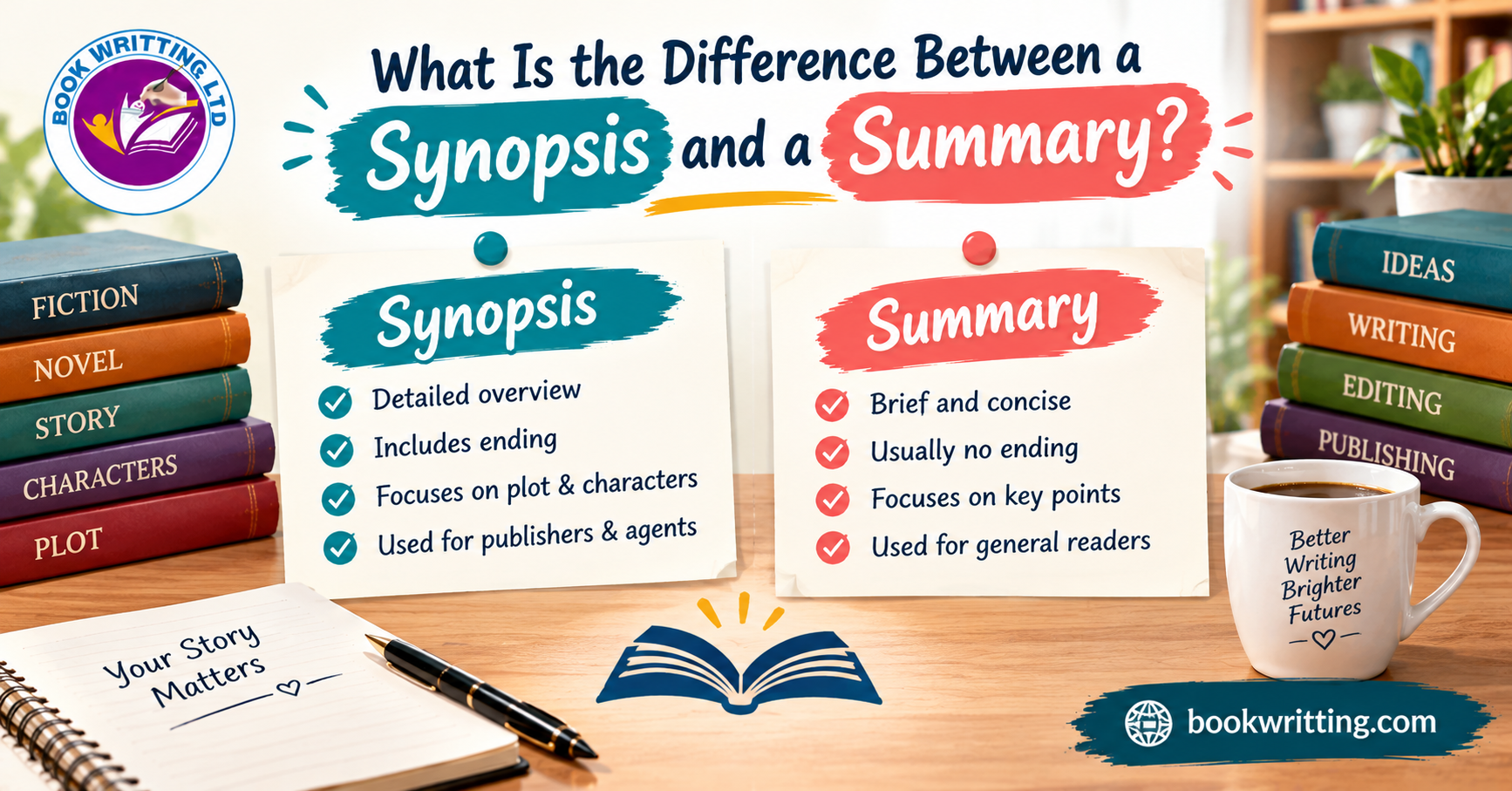
A synopsis is a structured overview of a book, story, screenplay, or other substantial piece of writing. It explains the central storyline, introduces important characters, identifies the main conflict, and describes how the narrative develops.
In fiction, a synopsis usually includes the ending, particularly when it is prepared for a literary agent or publisher. The purpose is to show that the author has developed a complete and coherent story.
A synopsis typically includes:
The main characters and their motivations
The central conflict or problem
Major plot developments and turning points
Important relationships or subplots
The resolution or ending
For nonfiction, a synopsis may explain the book's central argument, major topics, chapter structure, and intended purpose.
Example of a Synopsis
Imagine a mystery novel about a young journalist who returns to her hometown to investigate a decades-old disappearance. As she interviews former residents, she discovers conflicting accounts and uncovers a connection between the missing person and her own family. Her investigation eventually reveals the truth, forcing her to choose between protecting her family's reputation and exposing what happened.
This synopsis outlines the central character, the main conflict, the significant development, and the resolution of the mystery.
What Is a Summary?
A summary is a shortened version of a longer text that presents its most important information. It removes unnecessary details while preserving the central message or key events.
Summaries are widely used in education, business, journalism, research, and everyday communication. They help readers understand the essential information without reading the complete original material.
A summary typically includes:
The main idea or purpose
The most important events or arguments
Essential supporting information
The overall conclusion or message
Unlike a synopsis prepared for a publisher, a summary does not always need to explain every major plot development or reveal the ending. Its content depends on the purpose and intended audience.
Example of a Summary
A journalist returns to her hometown to investigate a long-standing disappearance. Her research uncovers conflicting stories, hidden family connections, and secrets that challenge what the community believes about the past.
This summary gives readers a brief overview of the story without explaining its complete development or revealing the final solution.
Key Differences Between a Synopsis and a Summary
Although both documents condense longer works, their emphasis and intended uses can differ.
Feature | Synopsis | Summary |
|---|---|---|
Main purpose | Present the structure and development of a work | Communicate the essential information |
Typical content | Main characters, conflict, plot developments, resolution | Main ideas, events, or arguments |
Level of detail | Often more detailed about the narrative | Usually concise and selective |
Ending | Usually included in fiction submission synopses | Depends on the purpose |
Common audience | Publishers, literary agents, writers | Students, readers, professionals |
Common use | Manuscript submissions and story planning | Reports, reviews, study notes, briefings |
These distinctions are general guidelines. The exact requirements depend on the assignment, publisher, or intended use.
Why Do Writers Need a Synopsis?
A synopsis is particularly useful when preparing a fiction manuscript for professional consideration. Publishers and literary agents may request one to evaluate the storyline before reading the entire manuscript.
A well-written synopsis can demonstrate that the author understands the story's structure and has developed a meaningful resolution.
Writers can also use a synopsis during the planning process. It helps identify weaknesses in the plot, unnecessary subplots, unclear motivations, or an ending that does not resolve the central conflict.
For nonfiction authors, a synopsis can communicate the book's subject, approach, organization, and value to its intended audience.
Why Are Summaries Important?
Summaries make information easier to understand and share. They allow readers to identify the most important points without reviewing an entire document.
Students use summaries to review lessons and understand reading assignments. Professionals use them to communicate reports, research findings, and meeting outcomes. Authors may also create summaries for articles, chapters, or book descriptions.
An effective summary requires careful selection. The writer must distinguish essential information from supporting details and present the main message in a clear, logical order.
How to Write an Effective Synopsis
Writing a synopsis can be challenging because a complete story must be condensed without losing its essential structure.
Follow these steps to get started.
1. Identify the Central Story
Write down the protagonist's main goal, the central conflict, and the outcome. For nonfiction, identify the main subject, argument, and intended result.
2. Select the Major Developments
Focus on the events or ideas that significantly influence the story or argument. Remove minor details that do not contribute to understanding the overall work.
3. Explain the Ending
For most fiction manuscript submissions, reveal how the central conflict is resolved. Publishers and literary agents generally need to understand the complete narrative.
4. Use Clear, Direct Language
Avoid lengthy descriptions, unnecessary dialogue, and excessive background information. Each sentence should help explain the story's structure or progression.
5. Check the Requirements
There is no universal synopsis length. Some publishers request one page, while others require several pages. Always follow the submission guidelines provided.
How to Write an Effective Summary
A strong summary captures the most important information while remaining concise and accurate.
Step 1: Read and understand the original text. Make sure you understand its central message before shortening it.
Step 2: Identify the key points. Highlight the main arguments, events, findings, or conclusions.
Step 3: Remove unnecessary details. Exclude repetition, minor examples, and information that does not support the main idea.
Step 4: Write in your own words. Express the essential information clearly while preserving the original meaning.
Step 5: Review for accuracy. Confirm that your summary does not misrepresent the original work or introduce unsupported claims.
Common Mistakes to Avoid
Writers can weaken both synopses and summaries by including too much information or failing to identify the document's purpose.
Avoid these common mistakes:
Confusing a synopsis with a promotional book blurb
Including too many minor details
Leaving out essential plot developments in a synopsis
Making a summary unnecessarily long
Adding personal opinions when an objective summary is required
Changing the meaning of the original work
Ignoring specific length or formatting requirements
The best approach is to identify your audience first, then include only the information that audience needs.
Get Professional Support for Your Writing
Preparing a manuscript, synopsis, or summary requires clarity, organization, and attention to detail. Reviewing your work carefully can improve readability and help you communicate your ideas more effectively.
If you need assistance with manuscript development, editing, publishing, or book marketing, explore the services available through Book Writting Ltd.
The main difference between a synopsis and a summary lies in their purpose and emphasis. A synopsis generally explains the structure and development of a book or story, often including the ending. A summary condenses the most important information into a shorter overview.
Both are valuable writing tools. Understanding when and how to use each one can help authors prepare professional submissions, students communicate key ideas, and readers understand complex material more easily.
Whether you are developing a novel, preparing a manuscript for publication, or summarizing an article, focus on accuracy, clarity, and the needs of your audience.