What Is the Difference Between an Anthology and a Collection? A Complete Guide
22 November 2026 · 7 min read
Books come in many different formats, and not every publication contains one continuous story. Some books bring together several short stories, poems, essays, or other literary works in a single volume. These publications are commonly described as anthologies or collections.
Although the two terms are sometimes used interchangeably, they can have different meanings in publishing.
Understanding the difference is useful for authors planning to publish multiple short stories, editors organizing contributions from different writers, and readers choosing books with several literary works.
Whether you're preparing a collection of your own stories or collaborating with other authors to create an anthology, knowing how these formats work can help you organize your project more effectively.
Let's explore the differences between an anthology and a collection, their common features, and how to choose the right format for your book.
1. What Is an Anthology?
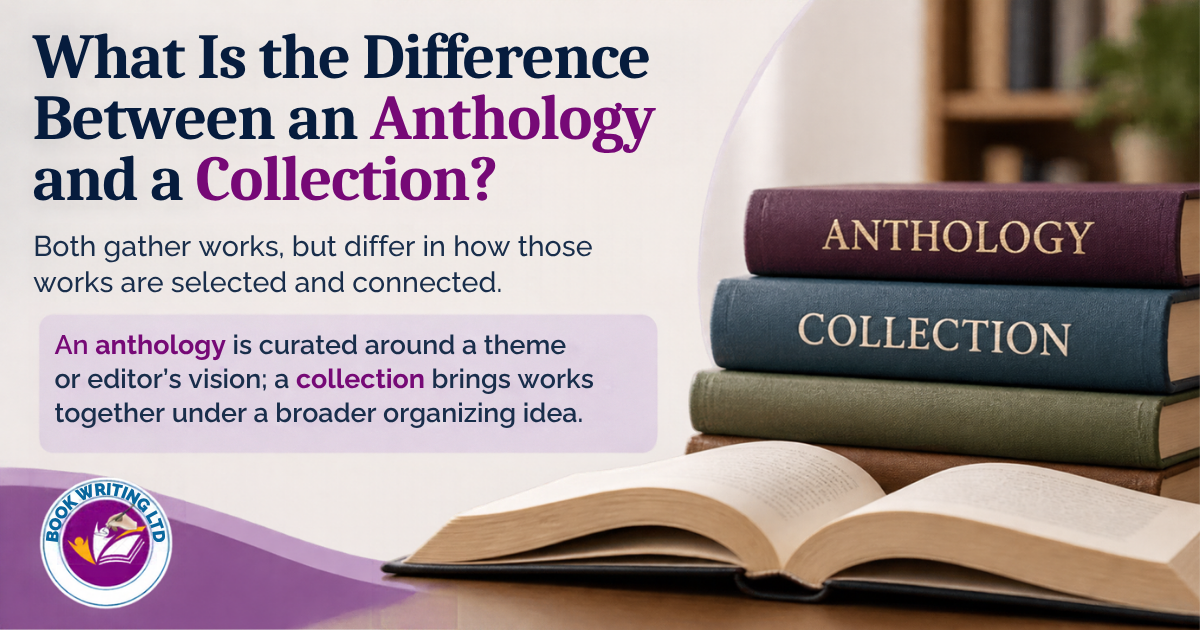
An anthology is a book that brings together selected literary works, often written by different authors, under one publication.
These works may include short stories, poems, essays, plays, or extracts from longer publications.
An editor or compiler usually selects and organizes the contributions according to a particular theme, genre, historical period, or subject.
For example, an anthology might contain:
Short stories from several mystery writers.
Poems written by different poets about nature.
Essays exploring personal experiences.
Fiction inspired by historical events.
Stories representing different cultural perspectives.
The individual contributions usually have their own subjects, characters, and writing styles, but they share a connection that brings the publication together.
Anthologies give readers an opportunity to discover different writers and perspectives within one book.
2. What Is a Collection?
A collection is a book containing several shorter literary works gathered into one publication.
In a common publishing convention, a collection generally contains works written by the same author.
For example, a novelist might publish a collection of previously written short stories, while a poet might bring together poems created over several years.
A collection may include:
Short stories.
Poems.
Essays.
Literary reflections.
Previously published articles.
Personal narratives.
The works may share a particular theme or explore different subjects.
For example, a writer might publish a collection of mystery stories featuring different characters and locations. Another author might create a poetry collection exploring love, nature, and personal experiences.
A collection allows readers to explore different pieces of one author's writing in a single volume.
3. Anthology vs. Collection: Key Differences
The most common publishing distinction concerns the number of contributing authors and how the works are assembled.
Feature | Anthology | Collection |
|---|---|---|
Contributors | Usually multiple authors | Usually one author |
Content | Selected literary works | Several works by an author |
Editorial role | Often curated by an editor | May be arranged by the author |
Main connection | Shared theme, genre, or subject | Author's writing or a common theme |
Writing styles | May vary between contributors | Usually reflects one author's style |
Collaboration | Often involves several writers | Can be prepared independently |
These are common conventions rather than absolute rules. Some anthologies contain works by a single author, and publishers may use the terms differently depending on the project.
The important distinction is to explain clearly who contributed to the book and how its contents were selected.
4. How Are Anthologies Organized?
Anthologies are usually organized around a central idea or editorial purpose.
The editor selects contributions that fit the publication's subject and creates an arrangement that makes the complete book enjoyable and understandable.
For example, a science fiction anthology might include stories from several writers exploring artificial intelligence, distant planets, futuristic societies, and technological discoveries.
Another anthology might focus on stories from a particular historical period or literary movement.
Editors may organize contributions according to:
Theme or subject.
Literary genre.
Historical period.
Geographical location.
Writing style.
A particular question or concept.
The editor's role is important because the selection and organization of individual contributions influence the overall reading experience.
5. How Are Collections Organized?
A collection is generally organized around the work of one writer.
The author decides which stories, poems, essays, or other pieces should appear in the publication.
Some collections follow a clear theme, while others provide a broader selection of the author's writing.
For example, a writer might organize a collection of short stories into sections about friendship, family relationships, and personal discovery.
A poetry collection might move from early works to more recent compositions, showing how the writer's style has developed.
A well-organized collection should have a clear structure, even when its individual pieces explore different subjects.
6. What Is the Role of an Editor?
Editors play an important role in both anthologies and collections, although their responsibilities may differ.
In an anthology, an editor may invite contributors, review submissions, select appropriate works, communicate with writers, arrange the contents, and coordinate revisions.
They also help establish the editorial direction of the publication.
In a collection, the author may take greater responsibility for selecting and organizing the material. An editor may then help improve structure, consistency, grammar, and readability.
Both formats benefit from careful editing and professional preparation.
For multi-author anthologies, clear communication about contributor credits, deadlines, permissions, and responsibilities is particularly important.
7. Can an Anthology Have a Common Theme?
Yes. A shared theme is one of the most useful ways to organize an anthology.
For example, an anthology might explore:
Mystery: Stories featuring investigations, unanswered questions, and unexpected discoveries.
Romance: Different romantic stories written by multiple authors.
Fantasy: Imaginary worlds, magical adventures, and extraordinary characters.
Historical Fiction: Stories inspired by different historical periods.
Personal Experiences: Essays reflecting on meaningful life events.
A common theme helps readers understand what connects the contributions.
However, the works do not have to follow one continuous storyline. Each contribution can offer a separate reading experience.
8. Can One Author Create an Anthology?
Yes. Although the term anthology commonly refers to works by multiple writers, it can also describe a curated collection of literary works by one author.
The terminology is not completely fixed across the publishing industry.
However, if you're publishing several short stories or poems written entirely by yourself, calling the book a collection will generally communicate its format more clearly to readers.
If you are selecting and arranging literary works for a particular purpose, the word anthology may also be appropriate depending on the publication's editorial approach.
When choosing a title and description, focus on helping potential readers understand exactly what the book contains.
9. How to Choose the Right Format for Your Book
Choosing between an anthology and a collection depends on your contributors, content, and publishing goals.
A collection may be suitable if you want to bring together several of your own stories, poems, or essays.
An anthology may be more appropriate when multiple writers contribute separate works to a shared publication.
Before deciding, consider:
How many authors will contribute?
What subjects will connect the works?
Will an editor select and organize the contributions?
Are the pieces previously published or newly written?
What audience do you want to reach?
How will contributors receive credit?
For collaborative anthologies, agree on contribution terms, permissions, ownership, royalties, and promotional responsibilities before publication.
Clear planning can help prevent misunderstandings and make the publishing process more organized.
Conclusion
Although anthologies and collections both bring multiple literary works together in one book, they often differ in their contributors and editorial approach.
An anthology usually brings together selected works from multiple writers, while a collection commonly features several works by one author.
Both formats offer opportunities to present short stories, poems, essays, and other literary material in an organized publication.
Whether you're planning to publish your own collection or collaborate with other writers on an anthology, choose a structure that accurately represents your content and gives readers a clear understanding of what to expect.
With thoughtful selection, careful organization, professional editing, and effective publishing preparation, you can create a literary publication that readers will enjoy exploring.
For more writing inspiration, manuscript preparation, editing, proofreading, publishing, and book marketing resources, visit Book Writting Ltd and explore services designed to support your publishing journey.