What Is the Difference Between Editing and Proofreading?
30 October 2026 · 7 min read
Writing a book is an exciting achievement, but completing the first draft does not necessarily mean the manuscript is ready for publication. Even well-written books can contain unclear sentences, structural problems, repeated ideas, spelling mistakes, or punctuation errors. This is why editing and proofreading are important parts of the publishing process.
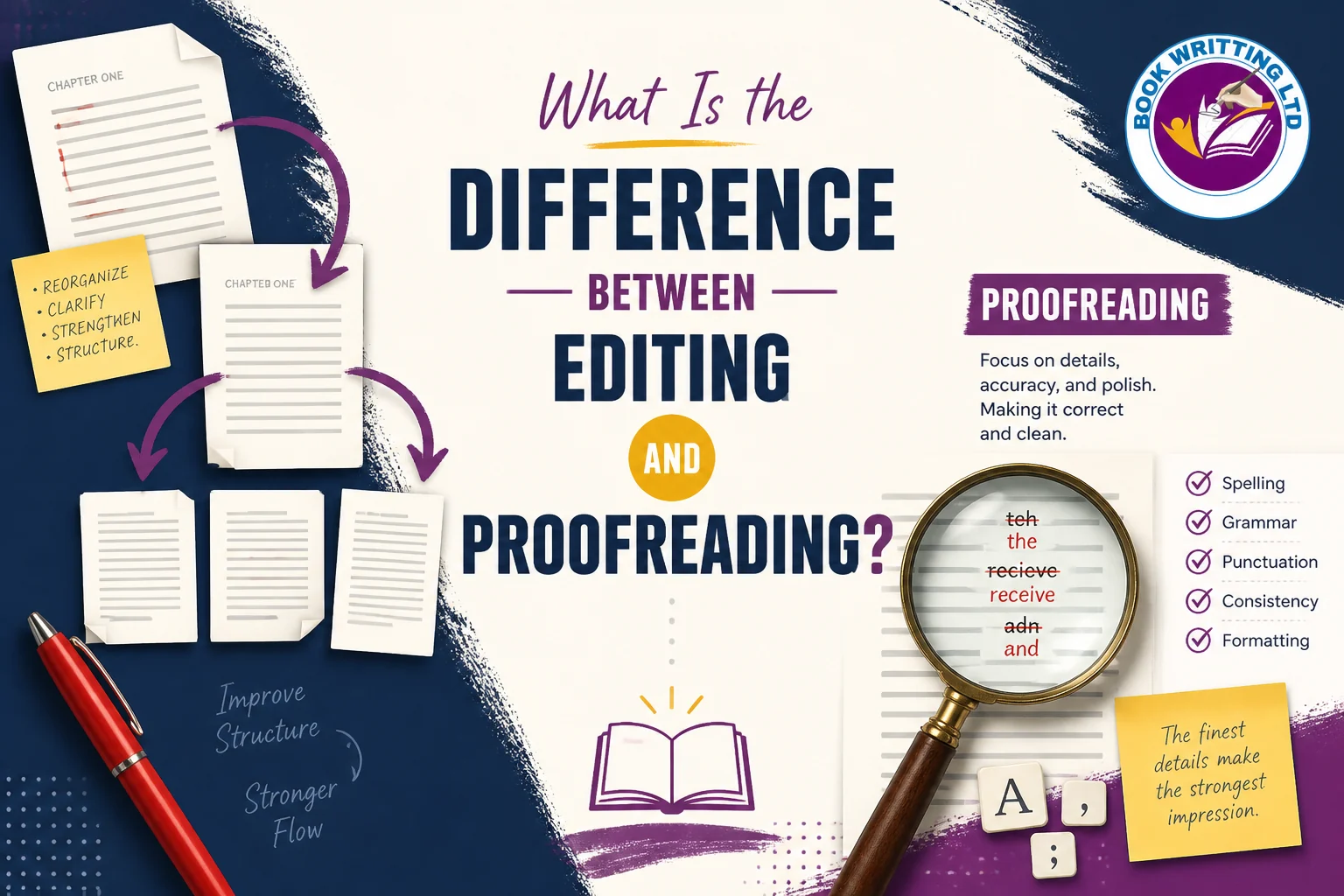
Although people sometimes use the terms interchangeably, editing and proofreading serve different purposes. Both help improve a manuscript, but they focus on different aspects of the writing.
Understanding the difference between these two processes can help authors prepare their manuscripts more effectively, communicate with publishing professionals, and produce a polished final book.
1. What Is Editing?
Editing is the process of reviewing and improving written content to make it clearer, more effective, consistent, and engaging.
An editor examines the manuscript beyond simple spelling mistakes. Depending on the type of editing, the work may involve improving the structure, refining sentences, strengthening arguments, developing characters, and correcting grammatical problems.
For fiction, editing may focus on plot development, pacing, character motivation, dialogue, and consistency. For nonfiction, it may involve organizing information, improving explanations, checking logical connections, and removing unnecessary repetition.
The main purpose of editing is to improve the overall quality of the manuscript while preserving the author's intended message and voice.
2. What Is Proofreading?
Proofreading is the final quality-checking stage of a manuscript, generally performed after editing and typesetting or formatting.
A proofreader examines the finished text for remaining surface-level errors and presentation problems. These may include:
Spelling mistakes and typographical errors.
Incorrect punctuation.
Missing or repeated words.
Inconsistent capitalization.
Formatting inconsistencies.
Incorrect page numbers or headings.
Spacing and layout problems.
Proofreading helps ensure that the final version looks professional and is ready for publication.
Unlike comprehensive editing, proofreading does not normally involve rewriting paragraphs, restructuring chapters, or substantially changing the author's content.
3. Key Differences Between Editing and Proofreading
Both processes improve written work, but their responsibilities are different.
Editing | Proofreading |
|---|---|
Improves the quality of the writing | Checks the final text for remaining errors |
May restructure sentences and paragraphs | Usually avoids substantial rewriting |
Focuses on clarity, flow, consistency, and content | Focuses on spelling, punctuation, and presentation |
Can involve substantial changes | Usually involves smaller corrections |
Takes place before final proofreading | Usually takes place near the end of production |
For example, an editor might rewrite a confusing paragraph to make its meaning clearer. A proofreader might correct a spelling mistake or identify a missing punctuation mark in the final formatted version.
Both contribute to a professional manuscript, but they solve different problems.
4. Different Types of Editing
Editing is not a single activity. Different stages may be required depending on the manuscript's condition and the author's goals.
Developmental Editing
Developmental editing focuses on the overall structure and content of a manuscript.
For fiction, this may include reviewing the plot, characters, pacing, conflicts, and story progression. For nonfiction, it may involve evaluating the organization of chapters, the strength of arguments, and the usefulness of the material.
A developmental editor helps identify larger problems that could affect the reader's experience.
Structural Editing
Structural editing examines how the manuscript is organized. It considers the sequence of chapters, the flow of information, the balance between sections, and whether the overall structure supports the book's purpose.
It may overlap with developmental editing, depending on the editor and the project.
Line Editing
Line editing focuses on language and expression. It improves sentence flow, word choice, clarity, rhythm, tone, and readability.
The goal is to make the writing more effective while maintaining the author's distinctive voice.
Copyediting
Copyediting focuses on grammar, spelling, punctuation, syntax, consistency, and language conventions. It may also include checking terminology, names, capitalization, and other editorial details.
Copyediting helps make the manuscript accurate and consistent at the sentence level.
These editing services can be combined or offered separately, depending on the manuscript and the agreed scope of work.
5. Why Do Authors Need Both Editing and Proofreading?
Editing and proofreading work together to improve the quality of a book.
Editing helps strengthen the manuscript before publication. It can uncover structural weaknesses, unclear explanations, inconsistent characters, and unnecessary repetition.
Proofreading then provides a final check after the content has been revised and formatted.
Imagine publishing a novel with an interesting plot but confusing dialogue and inconsistent character details. Proofreading alone would not normally resolve those larger problems. Similarly, an expertly edited manuscript could still contain a few typographical errors in its final layout.
Using both processes helps address different levels of quality.
Authors should avoid treating proofreading as a replacement for editing. Correct spelling and punctuation cannot automatically make an unclear or poorly structured manuscript effective.
6. When Should You Edit and Proofread Your Manuscript?
The order of the publishing process matters because making large changes after final proofreading can create additional work.
A practical workflow usually follows these stages:
Step 1: Complete the first draft.
Finish writing the manuscript before attempting to perfect every sentence. This gives you a complete version that can be evaluated as a whole.
Step 2: Review the content and structure.
Consider developmental or structural editing to address major issues involving organization, plot, characters, or content.
Step 3: Improve the writing.
Use line editing and copyediting as appropriate to improve clarity, style, grammar, and consistency.
Step 4: Format the manuscript.
Prepare the book's interior layout for its intended publishing format, such as paperback or ebook.
Step 5: Proofread the formatted version.
Check the final pages for remaining language, typography, and layout errors before approving publication.
The exact workflow can vary, and some projects may combine editorial stages. However, completing substantial revisions before final proofreading generally makes the process more efficient.
7. Common Mistakes Authors Should Avoid
Writers sometimes underestimate the importance of professional manuscript preparation.
Here are several mistakes to watch for:
Relying only on spellcheck: Automated tools may miss awkward sentences, incorrect word choices, and contextual errors.
Skipping editing: A manuscript can contain structural or clarity problems even when its grammar is correct.
Proofreading too early: Major revisions after proofreading can introduce new errors.
Ignoring consistency: Names, terminology, dates, headings, and formatting should remain consistent.
Editing without considering the author's voice: Improvements should strengthen the writing rather than remove its distinctive personality.
Taking time to review the manuscript carefully can help avoid these problems and produce a better reading experience.
8. Finding Professional Editing and Proofreading Support
Editing an entire book can be demanding, particularly when authors are closely connected to their own writing. An independent editorial perspective can help identify issues that the author may overlook.
Before choosing an editing or proofreading service, understand what is included. Ask about the scope of work, level of editing, turnaround arrangements, revision policies, and whether the service includes a final proofread.
Authors preparing their manuscripts for publication can explore writing, editing, proofreading, publishing, and book marketing services through Book Writting Ltd.
Choosing the right support depends on the condition of your manuscript and the improvements it needs.
Editing and proofreading are both essential parts of preparing a professional manuscript, but they serve different purposes. Editing improves the content, structure, clarity, and language, while proofreading checks the final version for remaining mistakes and presentation issues.
For the best results, authors should consider the condition of their manuscript, select the appropriate editing services, and arrange proofreading after substantial revisions and formatting are complete.
Remember that a polished book is not created through writing alone. Careful reviewing, editing, and proofreading help transform a draft into a manuscript that readers can enjoy with confidence.