What's the Difference Between a Novella and a Novel? Understanding Length, Scope, and Structure
2 November 2026 · 8 min read
Writers often have exciting story ideas but struggle to decide how long their manuscripts should be. Some stories can be told effectively in a relatively short format, while others need more space for detailed characters, multiple storylines, and complex conflicts.
This raises an important question: what's the difference between a novella and a novel?
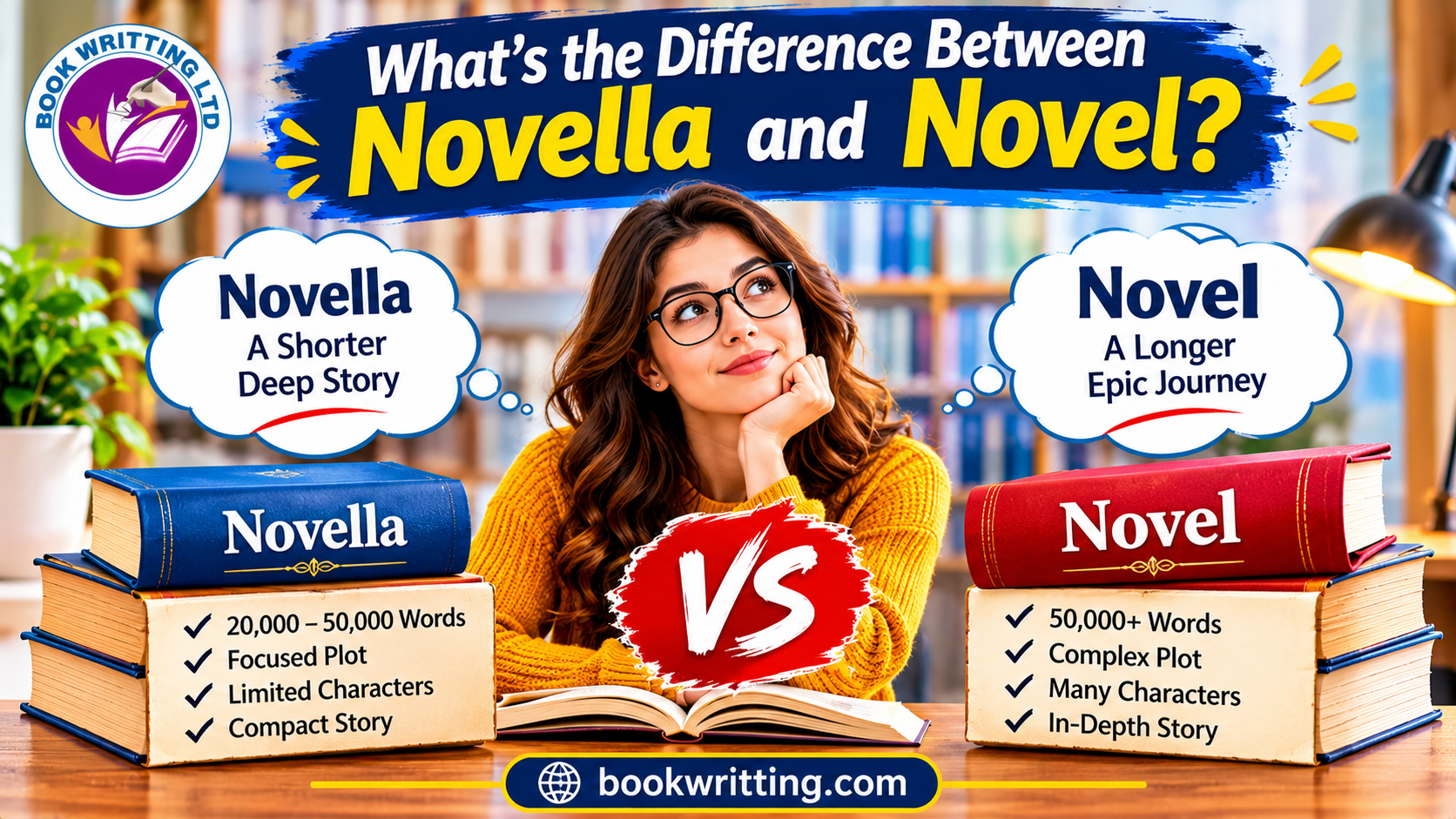
Although both are forms of fictional storytelling, they generally differ in length, narrative scope, character development, and plot complexity. A novella usually presents a focused story with a limited number of major events, while a novel provides more room for extended narratives, relationships, and additional storylines.
Understanding these differences can help writers choose the right format, organize their ideas, and create a manuscript that suits their storytelling goals.
1. What Is a Novella?
A novella is a fictional work that falls between a short story and a full-length novel in terms of length and scope.
It provides more room for character development and plot progression than a typical short story, but it usually maintains a more focused structure than a novel.
A novella often concentrates on one central conflict, a relatively small group of important characters, and a limited sequence of events.
For example, a novella might explore how a person handles an unexpected discovery that changes their relationship with a family member. The story could follow the situation from discovery to resolution without introducing several unrelated subplots.
Novellas are particularly useful when an idea needs more development than a short story can provide but does not require the length of a full novel.
2. What Is a Novel?
A novel is a longer work of fictional storytelling that allows writers to explore characters, relationships, conflicts, and settings in greater depth.
Novels can include multiple characters, connected storylines, detailed fictional environments, and events that unfold over extended periods.
For example, a historical novel might follow several generations of a family while exploring social changes, personal ambitions, relationships, and important historical events.
A fantasy novel may introduce an elaborate fictional world, multiple communities, magical systems, and several interconnected conflicts.
Because novels offer more narrative space, writers have greater opportunities to develop complicated situations and show how characters change throughout the story.
However, longer does not automatically mean better. Every chapter and subplot should contribute something meaningful to the reader's experience.
3. Novella vs. Novel: Key Word Count Differences
One of the most noticeable differences between a novella and a novel is word count.
There is no universal definition that applies to every publishing market. However, the Science Fiction and Fantasy Writers Association (SFWA) uses specific word-count categories for its Nebula Awards.
According to its classification:
Fiction Type | Word Count |
|---|---|
Short Story | Under 7,500 words |
Novelette | 7,500–17,499 words |
Novella | 17,500–39,999 words |
Novel | 40,000 words or more |
These are official award-category boundaries, particularly relevant to science fiction and fantasy, rather than universal publishing requirements. Individual publishers, literary agents, and competitions may use different definitions. (See the SFWA Nebula Awards Rules.)
The important point is that word count provides a useful starting point, but the structure and purpose of the story also matter.
4. Differences in Plot Complexity
Novellas and novels often approach storytelling differently.
A novella generally focuses on one central storyline. It may include a few important supporting characters, but most events contribute directly to the main conflict.
A novel has more room for additional plotlines, secondary conflicts, and complicated relationships.
For example:
Novella example: A young journalist discovers a forgotten letter that reveals an important secret about a historical family. The story follows the investigation and its consequences.
Novel example: A journalist investigates the same discovery, but the story also explores several family members, historical events, professional relationships, and connected mysteries over many years.
Both formats can tell compelling stories. The appropriate choice depends on how much development your idea genuinely needs.
5. Character Development in Novellas and Novels
Characters are essential to both forms, but the available space influences how their journeys are presented.
In a novella, writers often focus on a small number of central characters. Their personalities, motivations, and conflicts are developed through a concentrated sequence of experiences.
The story may follow one significant decision or personal transformation.
In a novel, writers have more room to explore several characters and their individual journeys. Supporting characters may have their own motivations, relationships, and smaller story arcs.
This allows a novel to examine how different people respond to the same central problem.
However, a novella can still contain memorable characters, and a novel does not necessarily need a large cast. The important thing is to develop characters in a way that supports the story.
6. How Pacing Differs Between a Novella and a Novel
Pacing refers to how quickly or slowly a story develops.
Novellas generally maintain a concentrated narrative. Important developments may occur relatively close together because the story has less space for extended background information or secondary events.
Novels can move through a wider range of experiences. Writers may include quieter chapters, detailed descriptions, multiple settings, and additional character interactions between major plot developments.
For example, a suspenseful novella might concentrate on a single investigation over several days. A suspense novel might explore several investigations, relationships, and discoveries over a much longer period.
Neither approach is automatically better. The pacing should match the story's purpose and keep readers interested.
7. Which Genre Works Best for Each Format?
Both novellas and novels can work across many fictional genres. However, certain storytelling approaches may naturally suit one format more than another.
Romance: A novella can focus on one central relationship and its development. A novel may explore a longer relationship journey with additional characters and conflicts.
Mystery: A novella can investigate one focused puzzle, while a novel can introduce several connected clues and secondary mysteries.
Fantasy: A novella may explore one adventure or a smaller part of an imaginary world. A novel can provide more room for extensive world-building and multiple character journeys.
Science Fiction: A novella can explore one futuristic concept or situation in detail, while a novel may examine wider technological, social, or political consequences.
Literary Fiction: Both formats can explore relationships, identity, personal change, and meaningful experiences. The required length depends on the narrative.
The best format is the one that allows your particular story to develop naturally.
8. How to Choose Between Writing a Novella and a Novel
If you're unsure which format to choose, begin by examining your central story idea.
Ask yourself:
Can the main conflict be explored effectively through one focused storyline?
Do the characters need extensive development?
Are several subplots essential to the narrative?
Does the setting require considerable explanation?
Would additional chapters strengthen the story or simply make it longer?
If your idea can be communicated effectively through a concentrated narrative, a novella may be appropriate.
If the story requires multiple connected conflicts, significant character development, and a broader narrative journey, a novel may be a better choice.
You can also begin with an outline rather than deciding on an exact word count immediately. As your story develops, you may discover which format suits it best.
9. Common Mistakes Writers Should Avoid
New writers sometimes assume that a longer manuscript is always more impressive or that a novella is simply an incomplete novel.
Both assumptions can lead to unnecessary writing problems.
Here are some common mistakes to avoid:
Adding unnecessary material: Do not introduce extra chapters simply to increase word count.
Rushing important developments: Give characters and major events enough space to feel believable.
Including unnecessary subplots: Every subplot should contribute to the central narrative.
Ignoring pacing: Avoid lengthy sections that do not move the story forward.
Choosing a format too early: Allow the requirements of your story to influence its final length.
A focused novella can be just as meaningful and engaging as a full-length novel.
10. Prepare Your Manuscript for Publication
Once you have chosen your format and completed your manuscript, the next step is to review its structure, language, and overall presentation.
Editing can help improve character development, chapter organization, pacing, and clarity. Proofreading can identify remaining spelling, grammar, punctuation, and formatting errors before publication.
Authors should also research appropriate publishers, literary agents, or independent publishing options for their chosen format.
If you need assistance developing or preparing your manuscript, explore writing, editing, publishing, and book marketing services through Book Writting Ltd.
The main difference between a novella and a novel involves length, storytelling scope, and narrative development.
A novella generally presents a more focused story with a central conflict and limited supporting material. A novel provides greater space for complex characters, additional storylines, and broader fictional worlds.
Neither format is automatically better. The right choice depends on the idea you want to explore and the amount of storytelling needed to bring it to life.
Start with your central idea, develop your characters, and build a structure that supports the narrative. Whether you write a novella or a novel, focus on creating a complete, engaging story that readers will remember.