How Do Writers Find Story Ideas? Unveiling Creative Sparks
25 October 2026 · 6 min read
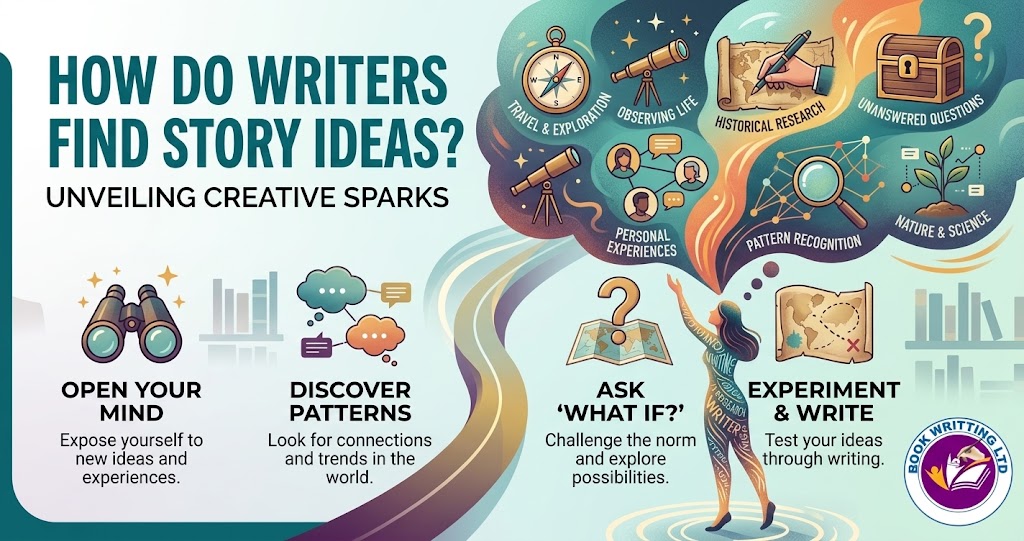
Every memorable story begins with an idea. Sometimes inspiration appears during an ordinary conversation, a visit to an unfamiliar place, or a moment of personal reflection. At other times, writers deliberately search for inspiration, experiment with different possibilities, and transform small observations into complete stories.
But how do writers consistently discover ideas that are interesting enough to become stories?
There is no single method that works for everyone. Writers draw inspiration from everyday life, personal experiences, historical events, scientific discoveries, books, and their own imaginations. The key is to remain curious, recognize interesting possibilities, and develop those possibilities through writing.
Whether you're planning a novel, short story, mystery, romance, or fantasy adventure, these practical techniques can help you find inspiration and turn it into a compelling narrative.
1. Observe the World Around You
Everyday life provides countless opportunities for discovering story ideas. A conversation between strangers, an unusual event in a neighborhood, or a person's unexpected reaction can inspire a character or situation.
Pay attention to details that other people might overlook. Notice how people communicate, how relationships change, and how ordinary situations sometimes produce surprising outcomes.
For example, seeing an unfamiliar key lying on a park bench might inspire a mystery. A conversation about an old family tradition could become the foundation of a historical story.
Keep a notebook or digital document for recording your observations. An individual detail may not seem particularly interesting at first, but it could become useful when combined with another idea.
Writers do not need extraordinary experiences every day. Learning to observe ordinary life carefully can provide a steady source of inspiration.
2. Draw Inspiration from Personal Experiences
Personal experiences can provide emotional depth and realistic details for fiction. Memories involving friendship, disappointment, discovery, ambition, uncertainty, or change may inspire situations that readers recognize.
You do not need to reproduce your experiences exactly as they happened. Instead, consider the emotions behind them and imagine how those emotions might influence a different character.
For example, the experience of entering an unfamiliar community could inspire a story about belonging and identity. A difficult decision might become the starting point for a novel about competing responsibilities.
You can also create stories about experiences you have never had. Imagination and research allow you to explore unfamiliar situations while building believable characters and settings.
The important thing is to use experience as a starting point rather than a limitation. Your fictional world can develop in unexpected directions.
3. Explore History and Unanswered Questions
Historical events offer rich possibilities for storytelling. Forgotten people, unusual traditions, unexplained decisions, and major turning points can inspire stories across many genres.
Start with a question that genuinely interests you. What was daily life like in a particular period? How might a major historical event have affected an ordinary family? What could happen if a character discovered a forgotten document?
Research reliable sources before developing a story based on real events. Historical details can help establish an authentic setting and provide opportunities for meaningful conflict.
You can also use historical research as inspiration for entirely fictional worlds. A real tradition, old invention, or social change might suggest an imaginative story set in the past, present, or future.
Curiosity often leads to ideas that would not emerge from brainstorming alone.
4. Ask “What If?”
One of the simplest ways to generate story ideas is to ask a hypothetical question.
What if a quiet village received a mysterious letter addressed to someone who disappeared years ago? What if a young inventor discovered a way to preserve memories? What if two strangers unknowingly pursued the same hidden truth?
Begin with something familiar and introduce one unexpected change. Then explore the consequences.
Ask how the situation would affect the characters, what problems it would create, and what difficult decisions might follow. Keep asking questions until you discover a conflict with enough potential to sustain a story.
You can create several variations from the same starting point by changing the setting, character, goal, or consequences.
Do not expect every idea to become a complete novel. The purpose of this exercise is to explore possibilities and identify the ones that most interest you.
5. Connect Different Interests
Creative ideas often emerge when seemingly unrelated subjects come together. Combining two interests can produce an unusual premise or a fresh approach to a familiar genre.
Imagine combining gardening with a mystery, astronomy with a family drama, or travel with a story about personal discovery.
Try writing down three topics that interest you, then experiment with different combinations. Consider how the subjects might influence the characters, setting, or central conflict.
Reading widely can make this process easier. Exploring science, history, art, psychology, nature, and different cultures introduces new information that may connect with ideas you already have.
You do not need to become an expert in every subject before using it as inspiration. Begin with curiosity, research what you need, and develop the concept thoughtfully.
6. Keep an Idea Journal
Inspiration can disappear as quickly as it arrives. Recording ideas helps you preserve them and gives you material to revisit when you need a new direction.
Your journal might include interesting observations, possible character traits, unusual settings, questions, snippets of dialogue, or alternative endings.
Do not judge every idea immediately. Record it first, even if it seems incomplete.
Later, review your notes and look for connections. Two separate observations might suggest a compelling conflict, while an unfinished premise could become more interesting when paired with a new character.
You can organize your journal into categories such as characters, settings, mysteries, relationships, historical discoveries, and hypothetical questions.
Over time, your journal becomes a personal collection of creative possibilities.
7. Turn Your Idea into a Story
Finding an idea is only the beginning. To develop it into a story, you need characters, a goal, a central problem, and meaningful consequences.
Start by answering four questions:
Who is the main character?
What does the character want?
What stands in the way?
Why does the outcome matter?
Consider a mysterious letter as an example. The idea becomes more compelling when you decide who receives it, what it reveals, why the message arrives now, and what the recipient must do next.
Write a short paragraph describing the possible story. If the premise continues to raise interesting questions, create a simple outline or draft an opening scene.
Allow the idea to change as you write. New characters and discoveries may improve the original concept.
Writers find story ideas through observation, personal experiences, historical research, imagination, reading, and unexpected connections. The most useful habit is to remain curious and record the details that make you stop and think.
Start by exploring one small idea, then develop it through characters, conflict, and meaningful choices. Experiment with different possibilities until you find a premise that you genuinely want to explore.
Not every idea will become a finished story, and that is a natural part of writing. Keep observing, keep asking questions, and keep experimenting.
Your next memorable story might begin with something as simple as an ordinary moment viewed from an unexpected perspective.
Ready to explore more writing tips and resources? Visit Book Writting Ltd to discover writing, editing, publishing, and book marketing services that can support your creative journey.