
What Are the Standard Parts of a Printed Book? A Complete Guide
24 November 2026 · 7 min read
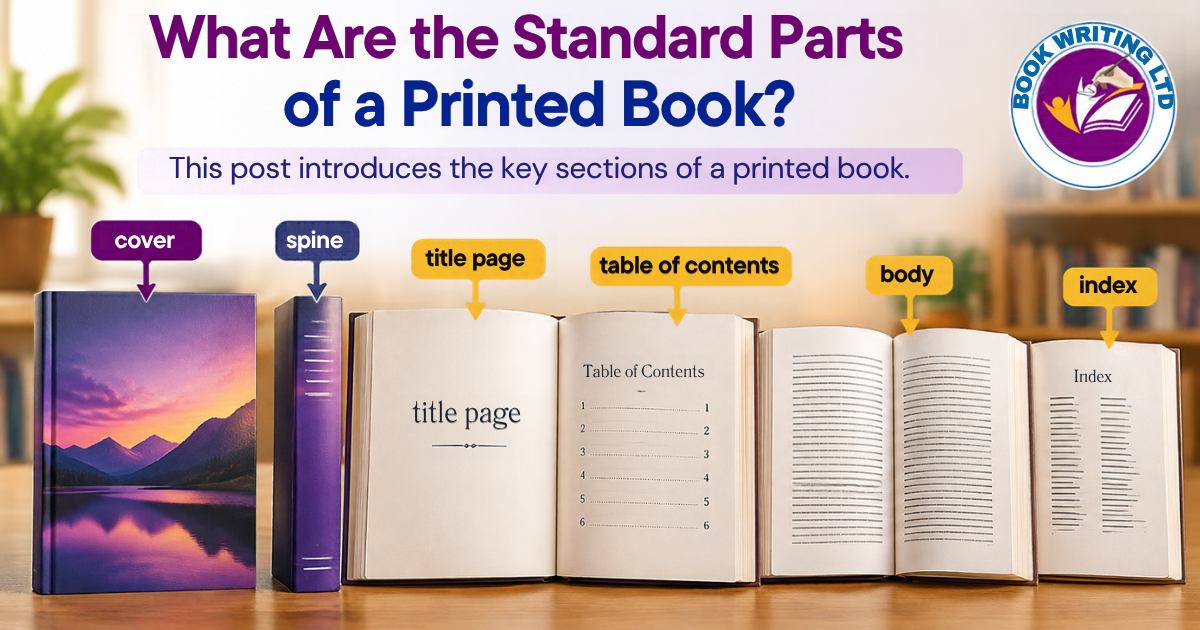
Have you ever opened a printed book and wondered why it contains different sections, pages, and design elements? From the protective outer cover to the pages containing the main story or information, every part of a book has a purpose.
Understanding the standard parts of a printed book is important for both readers and authors. It helps readers navigate publications more easily and allows writers to prepare their manuscripts for professional printing.
Although book structures vary depending on their genre, purpose, and publishing style, most printed books contain several familiar elements. These include the cover, spine, title page, table of contents, main body, and sometimes an index.
In this guide, we'll explore these important components, explain their functions, and show how they work together to create a complete printed book.
1. The Book Cover
The cover is the outer protective section of a printed book and one of the first things readers notice.
It protects the interior pages while introducing the book's title, author, and visual identity.
A professional front cover generally includes:
Book title.
Subtitle, when applicable.
Author's name.
Cover artwork or design.
Publisher information or branding, when appropriate.
The back cover may contain a book description, author biography, publisher information, ISBN barcode, and other promotional details.
Cover design should reflect the book's genre and intended audience. For example, a fantasy novel may use imaginative illustrations, while a business guide may have a clean and professional appearance.
An attractive cover creates a first impression and helps readers understand what kind of book they are considering.
2. The Book Spine
The spine is the narrow section connecting the front and back covers of a printed book.
It becomes visible when a book is placed upright on a shelf.
The spine commonly displays:
Book title.
Author's name.
Publisher logo or name, when applicable.
The spine should be designed clearly so readers can recognize the book without removing it from the shelf.
Its width depends on factors such as page count, paper thickness, and binding specifications.
Paperback and hardcover books may have different spine construction requirements.
Authors should calculate spine dimensions according to the printing service's specifications rather than estimating them manually.
A properly designed spine contributes to the book's professional appearance and shelf presentation.
3. The Title Page
The title page is an important page near the beginning of a book.
It introduces the publication and provides its essential identifying information.
A typical title page includes:
Full book title.
Subtitle, if applicable.
Author's name.
Publisher's name or logo, where applicable.
The title page is usually positioned after the preliminary publishing pages.
For example, a printed novel may begin with a copyright page, followed by a dedication or other introductory material, before reaching the title page.
The design is generally simple and readable. Its main purpose is to identify the book clearly rather than provide a detailed description of its contents.
4. The Table of Contents
The table of contents is a section that lists the chapters and major sections of a book.
It helps readers understand how the publication is organized and locate specific information.
Depending on the book, it may include:
Chapter titles.
Section headings.
Part titles.
Page numbers.
Appendices or supplementary sections.
For example, a nonfiction book about creative writing might contain chapters about character development, storytelling, editing, and publishing.
The table of contents allows readers to see these topics before reading the complete book.
It is particularly useful for textbooks, educational publications, business guides, reference books, and other publications with multiple sections.
Not every printed book requires a table of contents. Its inclusion depends on the publication's structure and the reader's needs.
5. The Main Body of the Book
The main body is the central section containing the primary content of the publication.
It is where readers find the story, information, arguments, explanations, or other material the author has created.
In fiction books, the main body usually contains chapters that develop the storyline, introduce characters, and present important events.
In nonfiction books, it may contain explanations, examples, instructions, research, and practical information.
A well-formatted main body should have:
Readable typography.
Consistent margins.
Appropriate line spacing.
Clear chapter headings.
Proper paragraph formatting.
Consistent page numbering.
The layout should make reading comfortable and help readers move through the content without unnecessary distractions.
The main body is the heart of the book because it delivers the material readers purchased or borrowed the publication to explore.
6. The Index
An index is an alphabetical list of important subjects, names, concepts, or terms discussed in a book, usually accompanied by page references.
It is commonly placed near the end of the publication.
For example, a business book might include index entries such as:
Branding.
Customer service.
Marketing.
Pricing.
Strategy.
Each entry may refer readers to the pages where the topic is discussed.
An index makes it easier to locate specific information without reading the entire book.
It is especially useful for textbooks, academic publications, technical manuals, professional guides, and reference books.
However, not every book needs an index. Fiction novels and many general-interest books are often published without one.
7. Other Important Sections of a Printed Book
In addition to the six main components, many printed books include other sections that provide useful information.
Copyright Page: Contains copyright information, publication details, ISBN, and other relevant publishing information.
Dedication Page: Allows the author to dedicate the book to a person or group.
Acknowledgements: Recognizes individuals or organizations that contributed to the project.
Foreword: An introductory section written by someone other than the author.
Preface: Explains the author's purpose, background, or approach to the book.
Introduction: Introduces the subject and prepares readers for the main content.
Glossary: Explains important words, technical terms, or unfamiliar concepts.
Bibliography or References: Lists sources used in the preparation of the book.
These additional sections are selected according to the book's purpose and publishing requirements.
8. Why Is Proper Book Formatting Important?
Understanding the parts of a printed book is only one stage of preparing a professional publication. Each component must also be organized and formatted correctly.
Poor formatting can make a book difficult to navigate and create an uncomfortable reading experience.
Before publication, authors should check:
Cover dimensions and design.
Spine width and alignment.
Title page information.
Table of contents accuracy.
Page numbering.
Chapter organization.
Margins and typography.
Index and reference formatting, where applicable.
It is also important to review a printed proof when available. This allows authors to identify layout problems before making the book available to readers.
Professional formatting helps create a publication that looks organized, consistent, and easy to read.
Every printed book contains different components that work together to create a complete reading experience.
The cover protects and introduces the publication, the spine helps identify it on a shelf, the title page presents its basic information, and the table of contents guides readers through its sections.
The main body contains the primary material, while an index helps readers locate specific information when one is included.
Other sections, such as copyright pages, acknowledgements, introductions, and bibliographies, provide additional information depending on the type of book.
Understanding these components can help authors make better formatting and publishing decisions.
Whether you're preparing your first novel, an educational guide, or a nonfiction publication, organizing every section carefully is an important step toward producing a professional printed book.
For more writing inspiration, manuscript preparation, editing, proofreading, publishing, and book marketing resources, visit Book Writting Ltd and explore services designed to support your publishing journey.